
Before Memmo my notes were scattered across PDFs. Now a workspace pulls everything into one place — I see exactly what's still left to study.
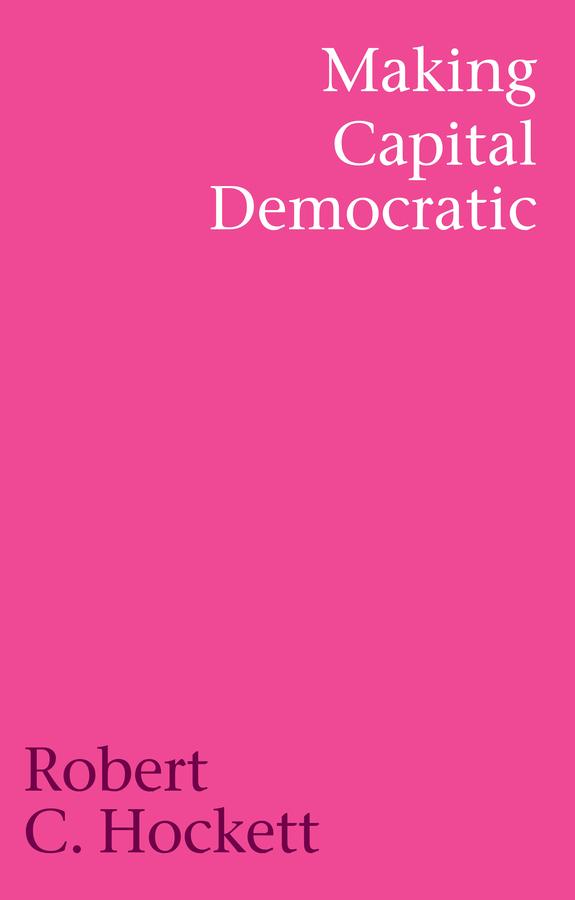
The underlying conceptual problem, Hockett contends, is that we miss the extent to which our financial systems are deeply and ineradicably public. Money is an inherent emanation of our basic social contract; capital in turn emerges as almost entirely publicly generated. Our systems of finance and investment must therefore be publicly and democratically determined. Leaving them in the hands of private powers means resigning ourselves to current health and income inequalities, evermore frequent financial crises, and economic stagnation and decline – to say nothing of social and political deterioration across the developed world.
Lucid and passionately argued, Making Capital Democratic is a seamless blend of philosophy and economics that calls for profound intellectual and institutional changes that would befit a democracy that is democratic in more than just name.
The “software” that structures our financial system and, through it, our broader economy is made up of certain basic concepts that guide how we think and hence act. These concepts include money, credit, finance, investment, and – above all – capital. This conceptual software manifests itself in our current “operating system” of institutions and practices. But our concepts and the system itself are radically out of date both as representations of monetary, financial, productive, and distributive reality and thus as realizations of democratically productive potential. Robert Hockett shows that this mismatch has serious consequences and argues that it’s time for a complete overhaul of our economic understanding. The underlying conceptual problem, Hockett contends, is that we miss the extent to which our financial systems are deeply and ineradicably public. Money is an inherent emanation of our basic social contract; capital in turn emerges as almost entirely publicly generated. Our systems of finance and investment must therefore be publicly and democratically determined. Leaving them in the hands of private powers means resigning ourselves to current health and income inequalities, evermore frequent financial crises, and economic stagnation and decline – to say nothing of social and political deterioration across the developed world. Lucid and passionately argued, Making Capital Democratic is a seamless blend of philosophy and economics that calls for profound intellectual and institutional changes that would befit a democracy that is democratic in more than just name.
Before Memmo my notes were scattered across PDFs. Now a workspace pulls everything into one place — I see exactly what's still left to study.
Memmo's summaries are gold before exams. I don't have to re-read 800 pages two weeks before — just the important parts.
The AI chat has saved me the night before an exam more than once. I just keep asking until I get it — no waiting on a study group to reply.
The quizzes hit exactly what I need to know. Memmo tracks what I get stuck on — so I only practice what's worth it.
Flashcards with spaced repetition are magic. Memmo knows when I'm about to forget something and brings it back.
The AI podcasts are my favorite. I listen on my way to school and get a recap without sitting at a computer.

Handbok i kvalitativa metoder
281 kr

Hållbar utveckling: en introduktion för ingenjörer och andra problemlösare
334 kr

Brymans Samhällsvetenskapliga metoder
390 kr

Projektledning
491 kr

Den orättvisa hälsan: om socioekonomiska skillnader i hälsa och livslängd
326 kr

Organizational Leadership
429 kr

Vetenskapsteori för nybörjare
196 kr

På väg mot läraryrket
172 kr

Det sociala livet i skolan: Socialpsykologiska perspektiv
253 kr

Betygsättningens didaktik
151 kr

Personality
402 kr

Studying Leadership
404 kr

Managing Innovation
477 kr

Introduktion till samhällsvetenskaplig metod
347 kr

The Psychology of Sex and Gender
698 kr

Evidens och kunskap för socialt arbete
207 kr

Introduction to Leadership
605 kr