
Before Memmo my notes were scattered across PDFs. Now a workspace pulls everything into one place — I see exactly what's still left to study.
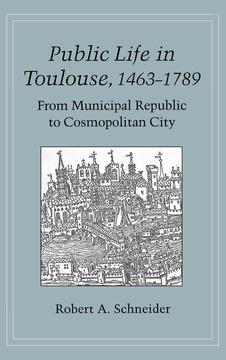
This book focuses on the public life of the ancien regime over the course of more than 300 years, from the late fifteenth century to the French Revolution. Not merely a narrative of that crowded history, it offers both a reconstruction and an analysis of a variety of religious and cultural movements, from the Renaissance and the Wars of Religion to the Counter-Reformation and the Enlightenment, within the social and political context of Toulouse, a regional capital and a city with a strong local tradition.
Professor Schneider takes up a wide range of early modern topics: popular culture, religious riots, municipal government, lay piety, and spiritual kinship, and he also treats learned academies, poor relief, social conflict, civic festivals, Jansenism, and urbanism. He discovers that despite the formation of a new elite in the late fifteenth and early sixteenth centuries—an elite composed of powerful royal magistrates attached to the Parlement of Toulouse and wealthy pastel merchants—the cultural and social ties binding this elite to the urban populace persisted, and the city's public life maintained its local character. Schneider shows that in the late seventeenth century, however, these "vertical" ties began to break down; elites began to turn away from local concerns, and Toulouse's public life was fundamentally transformed. He points to several factors influencing this transformation: the local effects of absolutism, the appeal of Parisian culture and academic life, and the increased social tensions between the prosperous and the poor. By the eighteenth century, Toulouse, once considered a municipal republic, had become a cosmopolitan city.
Relating developments in Toulouse to changes occurring elsewhere in France, this book heightens our understanding of the complex cultural ramifications of the rise of the increasingly centralized, absolutist state.
Before Memmo my notes were scattered across PDFs. Now a workspace pulls everything into one place — I see exactly what's still left to study.
Memmo's summaries are gold before exams. I don't have to re-read 800 pages two weeks before — just the important parts.
The AI chat has saved me the night before an exam more than once. I just keep asking until I get it — no waiting on a study group to reply.
The quizzes hit exactly what I need to know. Memmo tracks what I get stuck on — so I only practice what's worth it.
Flashcards with spaced repetition are magic. Memmo knows when I'm about to forget something and brings it back.
The AI podcasts are my favorite. I listen on my way to school and get a recap without sitting at a computer.

Handbok i kvalitativa metoder
281 kr

Hållbar utveckling: en introduktion för ingenjörer och andra problemlösare
334 kr

Brymans Samhällsvetenskapliga metoder
390 kr

Projektledning
491 kr

Den orättvisa hälsan: om socioekonomiska skillnader i hälsa och livslängd
326 kr

Vetenskapsteori för nybörjare
196 kr

Organizational Leadership
429 kr

På väg mot läraryrket
172 kr

Det sociala livet i skolan: Socialpsykologiska perspektiv
253 kr

Betygsättningens didaktik
151 kr

Personality
402 kr

Studying Leadership
404 kr

Managing Innovation
477 kr

Introduktion till samhällsvetenskaplig metod
347 kr

The Psychology of Sex and Gender
698 kr

Evidens och kunskap för socialt arbete
207 kr

Introduction to Leadership
605 kr