
Before Memmo my notes were scattered across PDFs. Now a workspace pulls everything into one place — I see exactly what's still left to study.
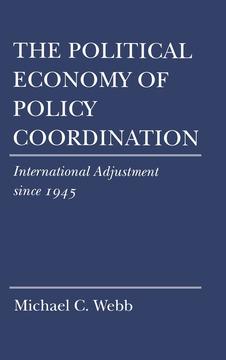
Michael C. Webb explores a central question about postwar economic history: how has the growth of international markets affected the coordination of economic policy among nations? His analysis overturns the popular assumption that policy coordination has eroded as American hegemony has receded. Instead, he argues that the growing mobility of capital forced governments to abandon the strategies they had used in the 1950s and 60s to insulate monetary and fiscal policies from international influences, and to move toward more direct coordination of central economic strategies.
Webb shows that since 1945 there has been a crucial shift in the pattern of international collaboration. He focuses on three types of adjustment policy: trade and capital controls, balance-of-payment lending and intervention in foreign-exchange markets, and monetary and fiscal policies. Noting that the first two types are no longer effective, he demonstrates that governments now rely more on monetary and fiscal policy coordination to regulate the global economy.
As the expansion of international finance created greater turbulence in the global economy in the 1980s, the liberal system of international trade threatened to collapse. Webb examines in particular how the United States, Japan, and Germany took unprecedented steps to coordinate monetary and fiscal policies in the late 1980s and early 1990s, although domestic political obstacles—not any decline in U.S. power—limited the impact of this policy coordination. He concludes by assessing the effectiveness of these attempts to reconcile the goal of a stronger liberal system of economic exchange with the desire to maintain national autonomy.
Before Memmo my notes were scattered across PDFs. Now a workspace pulls everything into one place — I see exactly what's still left to study.
Memmo's summaries are gold before exams. I don't have to re-read 800 pages two weeks before — just the important parts.
The AI chat has saved me the night before an exam more than once. I just keep asking until I get it — no waiting on a study group to reply.
The quizzes hit exactly what I need to know. Memmo tracks what I get stuck on — so I only practice what's worth it.
Flashcards with spaced repetition are magic. Memmo knows when I'm about to forget something and brings it back.
The AI podcasts are my favorite. I listen on my way to school and get a recap without sitting at a computer.

Handbok i kvalitativa metoder
281 kr

Hållbar utveckling: en introduktion för ingenjörer och andra problemlösare
334 kr

Brymans Samhällsvetenskapliga metoder
390 kr

Projektledning
491 kr

Den orättvisa hälsan: om socioekonomiska skillnader i hälsa och livslängd
326 kr

Organizational Leadership
429 kr

Vetenskapsteori för nybörjare
196 kr

På väg mot läraryrket
172 kr

Det sociala livet i skolan: Socialpsykologiska perspektiv
253 kr

Betygsättningens didaktik
151 kr

Personality
402 kr

Studying Leadership
404 kr

Managing Innovation
477 kr

Introduktion till samhällsvetenskaplig metod
347 kr

The Psychology of Sex and Gender
698 kr

Evidens och kunskap för socialt arbete
207 kr

Introduction to Leadership
605 kr