
Before Memmo my notes were scattered across PDFs. Now a workspace pulls everything into one place — I see exactly what's still left to study.
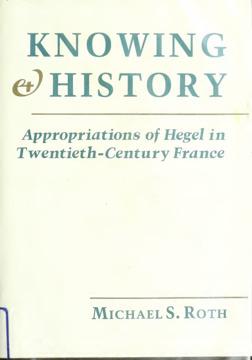
Knowing and History charts the development of Hegelian philosophy of history in France from the 1930s through the postwar period, and critically assesses its significance for an understanding of our cultural present and of the possibilities for making meaning out of change over time.
Michael Roth provides detailed analyses of the works of three of the most important Hegelian thinkers: Jean Hyppolite, Alexandre Kojève, and Eric Weil. These philosophers turned to history as the source of truths and criteria of judgment: they forged connections between history and knowing as a means of confronting key modem philosophical problems, and of engaging their contemporary political concerns. By the 1950s, however, they had withdrawn from the historical in search of a more secure, hopeful subject for reflection.
According to Roth, the French Hegelians' work illuminates the power and limitations of the philosophical approach to history. Further, he finds in the development of their philosophies one of the crucial transformations in modem intellectual history: the shift from a concern with questions of significance to a concern with questions of use or function. He seeks to explicate the contemporary retreat from questions of significance by situating our cultural moment in relation to its intellectual antecedents. In an Afterword devoted to French post-structuralism, the author discusses Hegel's replacement by Nietzsche as the locus of philosophical authority in France in the 1960s, and examines how this shift informs the work of Michel Foucault. Roth argues that the use of Nietzsche against a dialectical philosophy of history contributes to a serious disjunction between philosophical reflection and political judgment.
Relevant to a wide variety of disciplines, Knowing and History will appeal to those specializing in intellectual history and political theory, as well as philosophers of history, critical theorists, and students of modem French thought and culture.
Before Memmo my notes were scattered across PDFs. Now a workspace pulls everything into one place — I see exactly what's still left to study.
Memmo's summaries are gold before exams. I don't have to re-read 800 pages two weeks before — just the important parts.
The AI chat has saved me the night before an exam more than once. I just keep asking until I get it — no waiting on a study group to reply.
The quizzes hit exactly what I need to know. Memmo tracks what I get stuck on — so I only practice what's worth it.
Flashcards with spaced repetition are magic. Memmo knows when I'm about to forget something and brings it back.
The AI podcasts are my favorite. I listen on my way to school and get a recap without sitting at a computer.

Handbok i kvalitativa metoder
281 kr

Hållbar utveckling: en introduktion för ingenjörer och andra problemlösare
334 kr

Brymans Samhällsvetenskapliga metoder
390 kr

Projektledning
491 kr

Den orättvisa hälsan: om socioekonomiska skillnader i hälsa och livslängd
326 kr

Vetenskapsteori för nybörjare
196 kr

Organizational Leadership
429 kr

På väg mot läraryrket
172 kr

Det sociala livet i skolan: Socialpsykologiska perspektiv
253 kr

Betygsättningens didaktik
151 kr

Personality
402 kr

Studying Leadership
404 kr

Managing Innovation
477 kr

Introduktion till samhällsvetenskaplig metod
347 kr

The Psychology of Sex and Gender
698 kr

Evidens och kunskap för socialt arbete
207 kr

Introduction to Leadership
605 kr