
Before Memmo my notes were scattered across PDFs. Now a workspace pulls everything into one place — I see exactly what's still left to study.
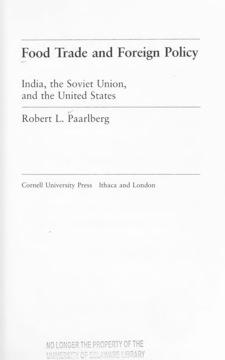
When U.S. Secretary of Agriculture Earl L. Butz announced in 1974 that "food is a weapon," he voiced a growing national belief in the political power of food resources. President Carter's 1980 decision to embargo grain sales to the Soviet Union appeared at first to confirm this popular notion. But can exporting nations, such as the United States, really use food as a powerful instrument of foreign policy? If so, are they using that weapon more frequently? Are importing nations taking steps to reduce their vulnerability? Challenging the view that food has emerged as a political weapon, Robert Paarlberg undertakes the first systematic inquiry into the relation between food resources and international power.
Paarlberg maintains that food trade is seldom manipulated for reasons of foreign policy, due to the greater priority assigned by most nations to domestic food and farm policy objectives. To support his argument, he reviews the recent grain trade experience of three significant and divergent nations—India, the Soviet Union, and the United States. He then examines in detail two exceptional instances in which the coercive power of the U.S. food weapon was put to the test: Lyndon Johnson's manipulation of food aid to India in 1965–1967 and the Carter embargo on grain sales to the Soviet Union in 1980–1981. He concludes that the difficulties experienced in each instance only reinforced the larger trend against linking grain trade policy to foreign policy—a trend that can be applauded by those concerned with world food security and trade efficiency.
Robert Paarlberg's challenge of the food power concept provides a valuable comparative insight into the conduct of national as well as international food policies.
Before Memmo my notes were scattered across PDFs. Now a workspace pulls everything into one place — I see exactly what's still left to study.
Memmo's summaries are gold before exams. I don't have to re-read 800 pages two weeks before — just the important parts.
The AI chat has saved me the night before an exam more than once. I just keep asking until I get it — no waiting on a study group to reply.
The quizzes hit exactly what I need to know. Memmo tracks what I get stuck on — so I only practice what's worth it.
Flashcards with spaced repetition are magic. Memmo knows when I'm about to forget something and brings it back.
The AI podcasts are my favorite. I listen on my way to school and get a recap without sitting at a computer.

Handbok i kvalitativa metoder
281 kr

Hållbar utveckling: en introduktion för ingenjörer och andra problemlösare
334 kr

Brymans Samhällsvetenskapliga metoder
390 kr

Projektledning
491 kr

Den orättvisa hälsan: om socioekonomiska skillnader i hälsa och livslängd
326 kr

Vetenskapsteori för nybörjare
196 kr

Organizational Leadership
429 kr

På väg mot läraryrket
172 kr

Det sociala livet i skolan: Socialpsykologiska perspektiv
253 kr

Betygsättningens didaktik
151 kr

Personality
402 kr

Studying Leadership
404 kr

Managing Innovation
477 kr

Introduktion till samhällsvetenskaplig metod
347 kr

The Psychology of Sex and Gender
698 kr

Evidens och kunskap för socialt arbete
207 kr

Introduction to Leadership
605 kr