
Before Memmo my notes were scattered across PDFs. Now a workspace pulls everything into one place — I see exactly what's still left to study.
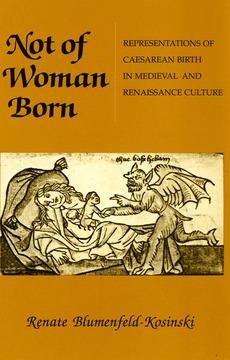
"Not of woman born, the Fortunate, the Unborn"—the terms designating those born by Caesarean section in medieval and Renaissance Europe were mysterious and ambiguous. Examining representations of Caesarean birth in legend and art and tracing its history in medical writing, Renate Blumenfeld-Kosinski addresses the web of religious, ethical, and cultural questions concerning abdominal delivery in the Middle Ages and the Renaissance. Not of Woman Born increases our understanding of the history of the medical profession, of medical iconography, and of ideas surrounding "unnatural" childbirth.
Blumenfeld-Kosinski compares texts and visual images in order to trace the evolution of Caesarean birth as it was perceived by the main actors involved—pregnant women, medical practitioners, and artistic or literary interpreters. Bringing together medical treatises and texts as well as hitherto unexplored primary sources such as manuscript illuminations, she provides a fresh perspective on attitudes toward pregnancy and birth in the Middle Ages and the Renaissance; the meaning and consequences of medieval medicine for women as both patients and practitioners, and the professionalization of medicine. She discusses writings on Caesarean birth from the twelfth and thirteenth centuries, when Church Councils ordered midwives to perform the operation if a mother died during childbirth in order that the child might be baptized; to the fourteenth century, when the first medical text, Bernard of Gordon's Lilium medicinae, mentioned the operation; up to the gradual replacement of midwives by male surgeons in the fifteenth and sixteenth centuries. Not of Woman Born offers the first close analysis of Frarnois Rousset's 1581 treatise on the operation as an example of sixteenth-century medical discourse. It also considers the ambiguous nature of Caesarean birth, drawing on accounts of such miraculous examples as the birth of the Antichrist. An appendix reviews the complex etymological history of the term "Caesarean section."
Richly interdisciplinary, Not of Woman Born will enliven discussions of the controversial issues surrounding Caesarean delivery today. Medical, social, and cultural historians interested in the Middle Ages and the Renaissance, historians, literary scholars, midwives, obstetricians, nurses, and others concerned with women's history will want to read it.
Before Memmo my notes were scattered across PDFs. Now a workspace pulls everything into one place — I see exactly what's still left to study.
Memmo's summaries are gold before exams. I don't have to re-read 800 pages two weeks before — just the important parts.
The AI chat has saved me the night before an exam more than once. I just keep asking until I get it — no waiting on a study group to reply.
The quizzes hit exactly what I need to know. Memmo tracks what I get stuck on — so I only practice what's worth it.
Flashcards with spaced repetition are magic. Memmo knows when I'm about to forget something and brings it back.
The AI podcasts are my favorite. I listen on my way to school and get a recap without sitting at a computer.

Handbok i kvalitativa metoder
281 kr

Hållbar utveckling: en introduktion för ingenjörer och andra problemlösare
334 kr

Brymans Samhällsvetenskapliga metoder
390 kr

Projektledning
491 kr

Den orättvisa hälsan: om socioekonomiska skillnader i hälsa och livslängd
326 kr

Vetenskapsteori för nybörjare
196 kr

Organizational Leadership
429 kr

På väg mot läraryrket
172 kr

Det sociala livet i skolan: Socialpsykologiska perspektiv
253 kr

Betygsättningens didaktik
151 kr

Personality
402 kr

Studying Leadership
404 kr

Managing Innovation
477 kr

Introduktion till samhällsvetenskaplig metod
347 kr

The Psychology of Sex and Gender
698 kr

Evidens och kunskap för socialt arbete
207 kr

Introduction to Leadership
605 kr