
Before Memmo my notes were scattered across PDFs. Now a workspace pulls everything into one place — I see exactly what's still left to study.
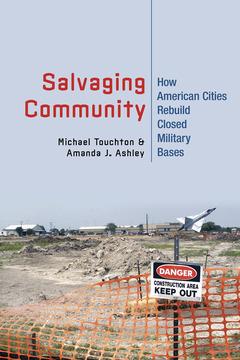
American communities face serious challenges when military bases close. But affected municipalities and metro regions are not doomed. Taking a long-term, flexible, and incremental approach, Michael Touchton and Amanda J. Ashley make strong recommendations for collaborative models of governance that can improve defense conversion dramatically and ensure benefits, even for low-resource municipalities. Communities can't control their economic situation or geographic location, but, as Salvaging Community shows, communities can control how they govern conversion processes geared toward redevelopment and reinvention.
In Salvaging Community, Touchton and Ashley undertake a comprehensive evaluation of how such communities redevelop former bases following the Department of Defense's Base Realignment and Closure (BRAC) process. To do so, they developed the first national database on military redevelopment and combine quantitative national analyses with three, in-depth case studies in California. Salvaging Community thus fills the void in knowledge surrounding redevelopment of bases and the disparate outcomes that affect communities after BRAC.
The data presented in Salvaging Community points toward effective strategies for collaborative governance that address the present-day needs of municipal officials, economic development agencies, and non-profit organizations working in post-BRAC communities. Defense conversion is not just about jobs or economic rebound, Touchton and Ashley argue. Emphasizing inclusion and sustainability in redevelopment promotes rejuvenated communities and creates places where people want to live. As localities and regions deal with the legacy of the post-Cold War base closings and anticipate new closures in the future, Salvaging Community presents a timely and constructive approach to both economic and community development at the close of the military-industrial era.
Before Memmo my notes were scattered across PDFs. Now a workspace pulls everything into one place — I see exactly what's still left to study.
Memmo's summaries are gold before exams. I don't have to re-read 800 pages two weeks before — just the important parts.
The AI chat has saved me the night before an exam more than once. I just keep asking until I get it — no waiting on a study group to reply.
The quizzes hit exactly what I need to know. Memmo tracks what I get stuck on — so I only practice what's worth it.
Flashcards with spaced repetition are magic. Memmo knows when I'm about to forget something and brings it back.
The AI podcasts are my favorite. I listen on my way to school and get a recap without sitting at a computer.

Handbok i kvalitativa metoder
281 kr

Hållbar utveckling: en introduktion för ingenjörer och andra problemlösare
334 kr

Brymans Samhällsvetenskapliga metoder
390 kr

Projektledning
491 kr

Den orättvisa hälsan: om socioekonomiska skillnader i hälsa och livslängd
326 kr

Organizational Leadership
429 kr

Vetenskapsteori för nybörjare
196 kr

På väg mot läraryrket
172 kr

Det sociala livet i skolan: Socialpsykologiska perspektiv
253 kr

Betygsättningens didaktik
151 kr

Personality
402 kr

Studying Leadership
404 kr

Managing Innovation
477 kr

Introduktion till samhällsvetenskaplig metod
347 kr

The Psychology of Sex and Gender
698 kr

Evidens och kunskap för socialt arbete
207 kr

Introduction to Leadership
605 kr