
Before Memmo my notes were scattered across PDFs. Now a workspace pulls everything into one place — I see exactly what's still left to study.
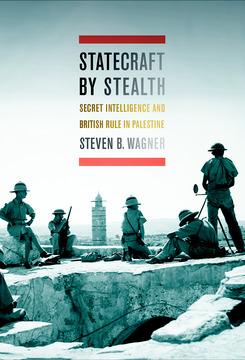
Britain relied upon secret intelligence operations to rule Mandatory Palestine. Statecraft by Stealth sheds light on a time in history when the murky triad of intelligence, policy, and security supported colonial governance. It emphasizes the role of the Anglo-Zionist partnership, which began during World War I and ended in 1939, when Britain imposed severe limits on Jewish immigration and settlement in Palestine.
Steven Wagner argues that although the British devoted considerable attention to intelligence gathering and analysis, they never managed to solve the basic contradiction of their rule: a dual commitment to democratic self-government and to the Jewish national home through immigration and settlement. As he deftly shows, Britain's experiment in Palestine shed all pretense of civic order during the Palestinian revolt of 1936–41, when the police authority collapsed and was replaced by a security state, created by army staff intelligence. That shift, Wagner concludes, was rooted in Britain's desire to foster closer ties with Saudi Arabia just before the start of World War II, and thus ended its support of Zionist policy.
Statecraft by Stealth takes us behind the scenes of British rule, illuminating the success of the Zionist movement and the failure of the Palestinians to achieve independence. Wagner focuses on four key issues to stake his claim: an examination of the "intelligence state" (per Martin Thomas's classic, Empires of Intelligence), the Arab revolt, the role of the Mufti of Jerusalem, and the origins and consequences of Britain's decision to end its support of Zionism.
Wagner crafts a superb story of espionage and clandestine policy-making, showing how the British pitted individual communities against each other at particular times, and why.
Before Memmo my notes were scattered across PDFs. Now a workspace pulls everything into one place — I see exactly what's still left to study.
Memmo's summaries are gold before exams. I don't have to re-read 800 pages two weeks before — just the important parts.
The AI chat has saved me the night before an exam more than once. I just keep asking until I get it — no waiting on a study group to reply.
The quizzes hit exactly what I need to know. Memmo tracks what I get stuck on — so I only practice what's worth it.
Flashcards with spaced repetition are magic. Memmo knows when I'm about to forget something and brings it back.
The AI podcasts are my favorite. I listen on my way to school and get a recap without sitting at a computer.

Handbok i kvalitativa metoder
281 kr

Hållbar utveckling: en introduktion för ingenjörer och andra problemlösare
334 kr

Brymans Samhällsvetenskapliga metoder
390 kr

Projektledning
491 kr

Den orättvisa hälsan: om socioekonomiska skillnader i hälsa och livslängd
326 kr

Organizational Leadership
429 kr

Vetenskapsteori för nybörjare
196 kr

På väg mot läraryrket
172 kr

Det sociala livet i skolan: Socialpsykologiska perspektiv
253 kr

Betygsättningens didaktik
151 kr

Personality
402 kr

Studying Leadership
404 kr

Managing Innovation
477 kr

Introduktion till samhällsvetenskaplig metod
347 kr

The Psychology of Sex and Gender
698 kr

Evidens och kunskap för socialt arbete
207 kr

Introduction to Leadership
605 kr