
Before Memmo my notes were scattered across PDFs. Now a workspace pulls everything into one place — I see exactly what's still left to study.
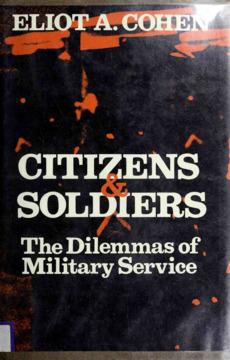
In the span of a generation, universal military service, universal military training, selective service, a lottery draft, and an all-volunteer armed force have all been either implemented or contemplated seriously in the United States. Why has the United States, unlike every other twentieth-century world power, failed to settle on a durable system of military service? In this informed and even-handed book, Eliot Cohen studies the enduring problems of America's methods of raising an army, seeking to analyze the nature of the many difficulties and the extent to which they can be overcome.
A nation's military service must reflect its political and geographical position in the world as well as its ideology. In the case of the United States, Cohen demonstrates, the attempt to satisfy these two types of requirements faces unique and intractable paradoxes. First, the United States must prepare for two completely different kinds of war, large- and small-scale, which for political and military reasons require two different kinds of armies; second, two important traditions—Anglo-Saxon liberalism and democratic egalitarianism—coexist uneasily in American thought and lead to opposing conceptions of citizens' obligations to serve their country.
Cohen's book is a long-needed antidote to the myopic preoccupation with short-term trends and fluctuations in recruiting statistics that characterizes the current manpower debate. Lucidly explaining complex issues, Cohen offers a broad comparative view of the historical events, political exigencies, and theoretical arguments that have shaped the military service systems of various countries. His discussion treats many important and timely issues: How shall we select some men—and possibly women—for service, and not others? How will our methods of recruitment affect our foreign policies, our domestic policies, and our forces' performance in battle? What methods have other countries adopted, how well did they work, and could they work here? His thoughtful and objective answers to these difficult questions will interest anyone concerned with contemporary American military policy today.
Before Memmo my notes were scattered across PDFs. Now a workspace pulls everything into one place — I see exactly what's still left to study.
Memmo's summaries are gold before exams. I don't have to re-read 800 pages two weeks before — just the important parts.
The AI chat has saved me the night before an exam more than once. I just keep asking until I get it — no waiting on a study group to reply.
The quizzes hit exactly what I need to know. Memmo tracks what I get stuck on — so I only practice what's worth it.
Flashcards with spaced repetition are magic. Memmo knows when I'm about to forget something and brings it back.
The AI podcasts are my favorite. I listen on my way to school and get a recap without sitting at a computer.

Handbok i kvalitativa metoder
281 kr

Hållbar utveckling: en introduktion för ingenjörer och andra problemlösare
334 kr

Brymans Samhällsvetenskapliga metoder
390 kr

Projektledning
491 kr

Den orättvisa hälsan: om socioekonomiska skillnader i hälsa och livslängd
326 kr

Vetenskapsteori för nybörjare
196 kr

Organizational Leadership
429 kr

På väg mot läraryrket
172 kr

Det sociala livet i skolan: Socialpsykologiska perspektiv
253 kr

Betygsättningens didaktik
151 kr

Personality
402 kr

Studying Leadership
404 kr

Managing Innovation
477 kr

Introduktion till samhällsvetenskaplig metod
347 kr

The Psychology of Sex and Gender
698 kr

Evidens och kunskap för socialt arbete
207 kr

Introduction to Leadership
605 kr