
Before Memmo my notes were scattered across PDFs. Now a workspace pulls everything into one place — I see exactly what's still left to study.
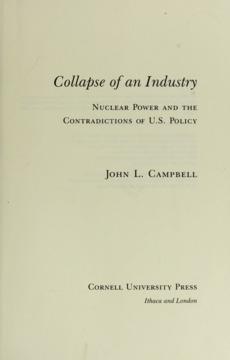
The commercial nuclear power industry was flourishing in the United States in the early 1970s; fifteen years later, the enterprise had collapsed. John L. Campbell examines the history of this debacle in order to explore how state and market shape each other under modern capitalism. In Collapse of an Industry, Campbell confronts controversial issues whose implications range far beyond the specifics of the nuclear power industry: the relative merits of free and controlled markets, the reliability of industrial planning, and the appropriate role of the state in managing economic activity. Ultimately, Campbell sheds light on the central question of whether modern democracy and capitalism may be essentially incompatible.
A complex, expensive, and potentially very dangerous technology, nuclear energy requires careful long-range planning to sustain commercial success. Campbell's narrative account shows how political and economic institutions unique to the United States made the nuclear energy industry particularly vulnerable to a series of policy failures that undermined that planning. Drawing on industry histories and trade publications, government documents and personal interviews, he considers four key areas central to the collapse of the sector: competition and the failure to standardize equipment; growing public concern over reactor safety and the disposal of radioactive waste; the industry's financial crisis; and the complex politics of regulation. Campbell argues that the democratic institutions of the contemporary United States will not support the predictable conditions needed for accumulation in so capital-intensive and potentially hazardous a sector as commercial nuclear power. He emphasizes the importance of institutional forms to the making of public policy by contrasting the industry's demise in the United States with its modest successes in Western Europe, demonstrating how variations in important governmental and private institutions affected the general health of the industry in France, Sweden, and West Germany.
A theoretically informed analysis free of the usual polemics about nuclear power, Collapse of an Industry merits the close attention of anyone concerned with the future of the commercial nuclear power industry.
Before Memmo my notes were scattered across PDFs. Now a workspace pulls everything into one place — I see exactly what's still left to study.
Memmo's summaries are gold before exams. I don't have to re-read 800 pages two weeks before — just the important parts.
The AI chat has saved me the night before an exam more than once. I just keep asking until I get it — no waiting on a study group to reply.
The quizzes hit exactly what I need to know. Memmo tracks what I get stuck on — so I only practice what's worth it.
Flashcards with spaced repetition are magic. Memmo knows when I'm about to forget something and brings it back.
The AI podcasts are my favorite. I listen on my way to school and get a recap without sitting at a computer.

Handbok i kvalitativa metoder
281 kr

Hållbar utveckling: en introduktion för ingenjörer och andra problemlösare
334 kr

Brymans Samhällsvetenskapliga metoder
390 kr

Projektledning
491 kr

Den orättvisa hälsan: om socioekonomiska skillnader i hälsa och livslängd
326 kr

Vetenskapsteori för nybörjare
196 kr

Organizational Leadership
429 kr

På väg mot läraryrket
172 kr

Det sociala livet i skolan: Socialpsykologiska perspektiv
253 kr

Betygsättningens didaktik
151 kr

Personality
402 kr

Studying Leadership
404 kr

Managing Innovation
477 kr

Introduktion till samhällsvetenskaplig metod
347 kr

The Psychology of Sex and Gender
698 kr

Evidens och kunskap för socialt arbete
207 kr

Introduction to Leadership
605 kr