
Before Memmo my notes were scattered across PDFs. Now a workspace pulls everything into one place — I see exactly what's still left to study.
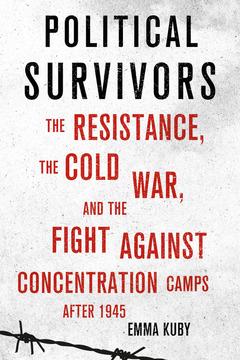
In 1949, as Cold War tensions in Europe mounted, French intellectual and former Buchenwald inmate David Rousset called upon fellow concentration camp survivors to denounce the Soviet Gulag as a "hallucinatory repetition" of Nazi Germany's most terrible crime. In Political Survivors, Emma Kuby tells the riveting story of what followed his appeal, as prominent members of the wartime Resistance from throughout Western Europe united to campaign against the continued existence of inhumane internment systems around the world. The International Commission against the Concentration Camp Regime brought together those originally deported for acts of anti-Nazi political activity who believed that their unlikely survival incurred a duty to bear witness for other victims. Over the course of the next decade, these pioneering activists crusaded to expose political imprisonment, forced labor, and other crimes against humanity in Franco's Spain, Maoist China, French Algeria, and beyond.
Until now, the CIA's secret funding of Rousset's movement has remained in the shadows. Kuby reveals this clandestine arrangement between European camp survivors and American intelligence agents. She also brings to light how Jewish Holocaust victims were systematically excluded from Commission membership – a choice that fueled the group's rise, but also helped lead to its premature downfall. The history that she unearths provides a striking new vision of how wartime memory shaped European intellectual life and ideological struggle after 1945, showing that the key lessons Western Europeans drew from the war centered on "the camp," imagined first and foremost as a site of political repression rather than ethnic genocide. Political Survivors argues that Cold War dogma and acrimony, tied to a distorted understanding of WWII's chief atrocities, overshadowed the humanitarian possibilities of the nascent anti-concentration camp movement as Europe confronted the violent decolonizing struggles of the 1950s.
Before Memmo my notes were scattered across PDFs. Now a workspace pulls everything into one place — I see exactly what's still left to study.
Memmo's summaries are gold before exams. I don't have to re-read 800 pages two weeks before — just the important parts.
The AI chat has saved me the night before an exam more than once. I just keep asking until I get it — no waiting on a study group to reply.
The quizzes hit exactly what I need to know. Memmo tracks what I get stuck on — so I only practice what's worth it.
Flashcards with spaced repetition are magic. Memmo knows when I'm about to forget something and brings it back.
The AI podcasts are my favorite. I listen on my way to school and get a recap without sitting at a computer.

Handbok i kvalitativa metoder
281 kr

Hållbar utveckling: en introduktion för ingenjörer och andra problemlösare
334 kr

Brymans Samhällsvetenskapliga metoder
390 kr

Projektledning
491 kr

Den orättvisa hälsan: om socioekonomiska skillnader i hälsa och livslängd
326 kr

Vetenskapsteori för nybörjare
196 kr

Organizational Leadership
429 kr

På väg mot läraryrket
172 kr

Det sociala livet i skolan: Socialpsykologiska perspektiv
253 kr

Betygsättningens didaktik
151 kr

Personality
402 kr

Studying Leadership
404 kr

Managing Innovation
477 kr

Introduktion till samhällsvetenskaplig metod
347 kr

The Psychology of Sex and Gender
698 kr

Evidens och kunskap för socialt arbete
207 kr

Introduction to Leadership
605 kr