
Before Memmo my notes were scattered across PDFs. Now a workspace pulls everything into one place — I see exactly what's still left to study.
Writing in 1940, the prominent German art historian Erwin Panofsky asked, How, then, is it possible to build up art history as a respectable scholarly discipline, if its objects come into being by an irrational and subjective process?"
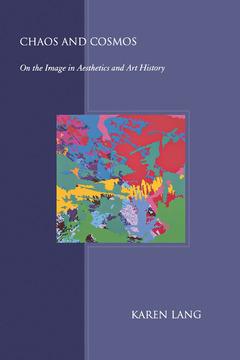
In Chaos and Cosmos, Karen Lang addresses the power of art to resist the pressures of the transcendental vantage point-history. Uncovering the intellectual and cultural richness of the early years of academic art history in Germany—the period from the 1880s to 1940—she explores various attempts within art history to transform aesthetic phenomena—chaos—into the cosmos of a systematic, unified field of inquiry.
Lang starts by examining Panofsky's approach to aesthetic phenomena in his early theoretical essays alongside Ernst Cassirer's contemporaneous publications on the substance and function of scientific concepts (and on Einstein's theory of relativity). She then turns to the subject of aesthetic judgment through a rereading of Kantian subjectivity and Kant's uneasy legacy in art history. From here, Lang considers the different organizing theories of symbolic form proposed by Aby Warburg and Cassirer, as well as Goethe's inspiration for both; Alois Riegl's notion of age value and Walter Benjamin's conceptions of the aura; concluding with an extended examination of objectivity and the figure of the art connoisseur.
Extensively illustrated with works of art from the Enlightenment to the present day, this venturesome book illuminates an intellectual legacy that has profoundly shaped the study of the history of art in ways that have, until now, been largely unacknowledged. Addressing the interplay of chaos and cosmos in terms of history, art history, philosophy, and epistemology, Lang traces shifts in point of view in art history and the way these shifts change aesthetic objects into historical objects, and even objects of knowledge.
Before Memmo my notes were scattered across PDFs. Now a workspace pulls everything into one place — I see exactly what's still left to study.
Memmo's summaries are gold before exams. I don't have to re-read 800 pages two weeks before — just the important parts.
The AI chat has saved me the night before an exam more than once. I just keep asking until I get it — no waiting on a study group to reply.
The quizzes hit exactly what I need to know. Memmo tracks what I get stuck on — so I only practice what's worth it.
Flashcards with spaced repetition are magic. Memmo knows when I'm about to forget something and brings it back.
The AI podcasts are my favorite. I listen on my way to school and get a recap without sitting at a computer.

Handbok i kvalitativa metoder
281 kr

Hållbar utveckling: en introduktion för ingenjörer och andra problemlösare
334 kr

Brymans Samhällsvetenskapliga metoder
390 kr

Projektledning
491 kr

Den orättvisa hälsan: om socioekonomiska skillnader i hälsa och livslängd
326 kr

Vetenskapsteori för nybörjare
196 kr

Organizational Leadership
429 kr

På väg mot läraryrket
172 kr

Det sociala livet i skolan: Socialpsykologiska perspektiv
253 kr

Betygsättningens didaktik
151 kr

Personality
402 kr

Studying Leadership
404 kr

Managing Innovation
477 kr

Introduktion till samhällsvetenskaplig metod
347 kr

The Psychology of Sex and Gender
698 kr

Evidens och kunskap för socialt arbete
207 kr

Introduction to Leadership
605 kr