
Before Memmo my notes were scattered across PDFs. Now a workspace pulls everything into one place — I see exactly what's still left to study.
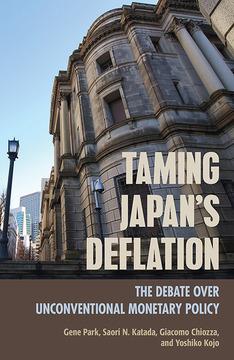
Bolder economic policy could have addressed the persistent bouts of deflation in post-bubble Japan, write Gene Park, Saori N. Katada, Giacomo Chiozza, and Yoshiko Kojo in Taming Japan's Deflation. Despite warnings from economists, intense political pressure, and well-articulated unconventional policy options to address this problem, Japan's central bank, the Bank of Japan (BOJ), resisted taking the bold actions that the authors believe would have significantly helped.
With Prime Minister Abe Shinzo's return to power, Japan finally shifted course at the start of 2013 with the launch of Abenomics—an economic agenda to reflate the economy—and Abe's appointment of new leadership at the BOJ. As Taming Japan's Deflation shows, the BOJ's resistance to experimenting with bolder policy stemmed from entrenched policy ideas that were hostile to activist monetary policy. The authors explain how these policy ideas evolved over the course of the BOJ's long history and gained dominance because of the closed nature of the broader policy network.
The explanatory power of policy ideas and networks suggests a basic inadequacy in the dominant framework for analysis of
the politics of monetary policy derived from the literature on central bank independence. This approach privileges the interaction between political principals and their supposed agents, central bankers; but Taming Japan's Deflation shows clearly that central bankers' views, shaped by ideas and institutions, can be decisive in determining monetary policy. Through a combination of institutional analysis, quantitative empirical tests, in-depth case studies, and structured comparison of Japan with other countries, the authors show that, ultimately, the decision to adopt aggressive monetary policy depends largely on the bankers' established policy ideas and policy network.
Before Memmo my notes were scattered across PDFs. Now a workspace pulls everything into one place — I see exactly what's still left to study.
Memmo's summaries are gold before exams. I don't have to re-read 800 pages two weeks before — just the important parts.
The AI chat has saved me the night before an exam more than once. I just keep asking until I get it — no waiting on a study group to reply.
The quizzes hit exactly what I need to know. Memmo tracks what I get stuck on — so I only practice what's worth it.
Flashcards with spaced repetition are magic. Memmo knows when I'm about to forget something and brings it back.
The AI podcasts are my favorite. I listen on my way to school and get a recap without sitting at a computer.

Handbok i kvalitativa metoder
281 kr

Hållbar utveckling: en introduktion för ingenjörer och andra problemlösare
334 kr

Brymans Samhällsvetenskapliga metoder
390 kr

Projektledning
491 kr

Den orättvisa hälsan: om socioekonomiska skillnader i hälsa och livslängd
326 kr

Organizational Leadership
429 kr

Vetenskapsteori för nybörjare
196 kr

På väg mot läraryrket
172 kr

Det sociala livet i skolan: Socialpsykologiska perspektiv
253 kr

Betygsättningens didaktik
151 kr

Personality
402 kr

Studying Leadership
404 kr

Managing Innovation
477 kr

Introduktion till samhällsvetenskaplig metod
347 kr

The Psychology of Sex and Gender
698 kr

Evidens och kunskap för socialt arbete
207 kr

Introduction to Leadership
605 kr