
Before Memmo my notes were scattered across PDFs. Now a workspace pulls everything into one place — I see exactly what's still left to study.
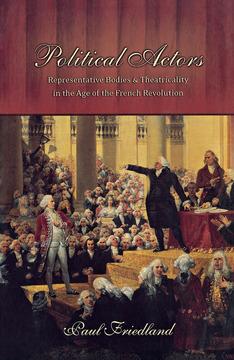
From the start of the French Revolution, contemporary observers were struck by the overwhelming theatricality of political events. Examples of convergence between theater and politics included the election of dramatic actors to powerful political and military positions and reports that deputies to the National Assembly were taking acting lessons and planting paid "claqueurs" in the audience to applaud their employers on demand. Meanwhile, in a mock national assembly that gathered in an enormous circus pavilion in the center of Paris, spectators paid for the privilege of acting the role of political representatives for a day.
Paul Friedland argues that politics and theater became virtually indistinguishable during the Revolutionary period because of a parallel evolution in the theories of theatrical and political representation. Prior to the mid-eighteenth century, actors on political and theatrical stages saw their task as embodying a fictional entity—in one case a character in a play, in the other, the corpus mysticum of the French nation. Friedland details the significant ways in which after 1750 the work of both was redefined. Dramatic actors were coached to portray their parts abstractly, in a manner that seemed realistic to the audience. With the creation of the National Assembly, abstract representation also triumphed in the political arena. In a break from the past, this legislature did not claim to be the nation, but rather to speak on its behalf.
According to Friedland, this new form of representation brought about a sharp demarcation between actors—on both stages—and their audience, one that relegated spectators to the role of passive observers of a performance that was given for their benefit but without their direct participation. Political Actors, a landmark contribution to eighteenth-century studies, furthers understanding not only of the French Revolution but also of the very nature of modern representative democracy.
Before Memmo my notes were scattered across PDFs. Now a workspace pulls everything into one place — I see exactly what's still left to study.
Memmo's summaries are gold before exams. I don't have to re-read 800 pages two weeks before — just the important parts.
The AI chat has saved me the night before an exam more than once. I just keep asking until I get it — no waiting on a study group to reply.
The quizzes hit exactly what I need to know. Memmo tracks what I get stuck on — so I only practice what's worth it.
Flashcards with spaced repetition are magic. Memmo knows when I'm about to forget something and brings it back.
The AI podcasts are my favorite. I listen on my way to school and get a recap without sitting at a computer.

Handbok i kvalitativa metoder
281 kr

Hållbar utveckling: en introduktion för ingenjörer och andra problemlösare
334 kr

Brymans Samhällsvetenskapliga metoder
390 kr

Projektledning
491 kr

Den orättvisa hälsan: om socioekonomiska skillnader i hälsa och livslängd
326 kr

Vetenskapsteori för nybörjare
196 kr

Organizational Leadership
429 kr

På väg mot läraryrket
172 kr

Det sociala livet i skolan: Socialpsykologiska perspektiv
253 kr

Betygsättningens didaktik
151 kr

Personality
402 kr

Studying Leadership
404 kr

Managing Innovation
477 kr

Introduktion till samhällsvetenskaplig metod
347 kr

The Psychology of Sex and Gender
698 kr

Evidens och kunskap för socialt arbete
207 kr

Introduction to Leadership
605 kr