
Before Memmo my notes were scattered across PDFs. Now a workspace pulls everything into one place — I see exactly what's still left to study.
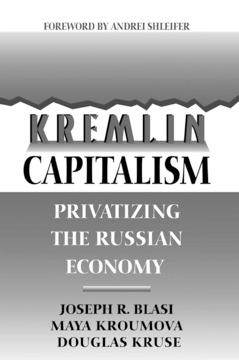
The first book to describe Russia's massive economic transformation for an American audience, Kremlin Capitalism provides a wealth of data and analyses not previously available in this country. The authors articulate the political and economic goals of Russian privatization, examine the current ownership of the largest enterprises in Russia, and chart the serious problem of corporate governance in the new private businesses.
Kremlin Capitalism is based on the only continuous study of Russian privatization throughout the Russian Federation from 1992 to the present. The authors tracked down the story of the transition in the cities, towns, and villages of fifty of Russia's eighty-nine provinces, updating their findings after the June 1996 election. The result is an up-to-the-minute report of the largest property transfer in history and an analysis of one of this century's most significant economic transformations. The volume also characterizes the position of workers in terms of unemployment, wages, union power, and their changing role as employee shareholders.
What really happened when Russia privatized its economy? The Kremlin brokered the initial struggle among different interest groups eager to claim a portion of Russian property: workers, managers, the Mafia, the old Soviet bureaucracy, regular citizens, entrepreneurs, Russian banks, and foreigners. While competing with one another, all struggled to free themselves from seventy years of Communist economic culture. Four years after the process began, have large companies learned to offer goods and services profitably and pay dividends to shareholders? Individual stories come alive as the book explores problems Russians face in structuring a new economic system, defining the ownership and governance of thousands of corporations one by one. Russian economic practices are being forged in the heat of fierce political struggles between resurgent Communists and nationalists and old Soviet managers, on the one hand, and more liberal elements of its infant democratic system on the other. Whether a few big conglomerates and the powerful banks and holding companies from Soviet days will dominate the new Russian economy to the exclusion of most citizens remains to be seen.
Many questions persist. How will billions of dollars of capital be raised to retool, restructure, and reorient the heart and soul of Russia's economy? Will open stock markets stimulate a new economic order or will that new order be imposed through strong state supports and subsidies? What role will be played by shadowy conglomerates that are trying to shape a disorganized economy into something resembling the old Soviet system?
The authors note the paradox of a capitalism conceived, designed, implemented, and evaluated by the Kremlin when one aim of reform is to allow market forces to play freely. Kremlin Capitalism asks whether rapid privatization has catalyzed or complicated the transition to a more liberal political and economic system, a question that will reverberate for decades.
Before Memmo my notes were scattered across PDFs. Now a workspace pulls everything into one place — I see exactly what's still left to study.
Memmo's summaries are gold before exams. I don't have to re-read 800 pages two weeks before — just the important parts.
The AI chat has saved me the night before an exam more than once. I just keep asking until I get it — no waiting on a study group to reply.
The quizzes hit exactly what I need to know. Memmo tracks what I get stuck on — so I only practice what's worth it.
Flashcards with spaced repetition are magic. Memmo knows when I'm about to forget something and brings it back.
The AI podcasts are my favorite. I listen on my way to school and get a recap without sitting at a computer.

Handbok i kvalitativa metoder
281 kr

Hållbar utveckling: en introduktion för ingenjörer och andra problemlösare
334 kr

Brymans Samhällsvetenskapliga metoder
390 kr

Projektledning
491 kr

Den orättvisa hälsan: om socioekonomiska skillnader i hälsa och livslängd
326 kr

Vetenskapsteori för nybörjare
196 kr

Organizational Leadership
429 kr

På väg mot läraryrket
172 kr

Det sociala livet i skolan: Socialpsykologiska perspektiv
253 kr

Betygsättningens didaktik
151 kr

Personality
402 kr

Studying Leadership
404 kr

Managing Innovation
477 kr

Introduktion till samhällsvetenskaplig metod
347 kr

The Psychology of Sex and Gender
698 kr

Evidens och kunskap för socialt arbete
207 kr

Introduction to Leadership
605 kr