
Before Memmo my notes were scattered across PDFs. Now a workspace pulls everything into one place — I see exactly what's still left to study.
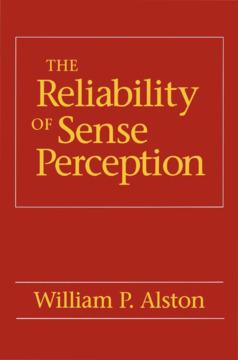
Why suppose that sense perception is an accurate source of information about the physical environment? More generally, is it possible to demonstrate that our basic ways of forming beliefs are reliable? In this book, a leading analytic philosopher confronts this classic problem through detailed investigation of sense perception, the source of beliefs in which we place the most confidence. Carefully assessing the available arguments, William P. Alston concludes that it is not possible to show in any noncircular way that sense perception is a reliable source of beliefs.
Alston thoroughly examines the main arguments that have been advanced for the reliability of sense perception, including arguments from the various kinds of success we achieve by relying on the sense perception, arguments that some features of our sense experience are best explained by supposing that it is an accurate guide, and arguments that there is something conceptually incoherent about the idea that sense perception is not reliable. He concludes that all of these arguments that are not disqualified in other ways are epistemically circular, for they use premises based upon the very source in question. Alston then suggest that the most appropriate response to the impossibility of showing that our basic sources of beliefs are reliable is an appeal to the practical rationality of engaging in certain socially established belief-forming practices.
The Reliability of Sense Perception will be welcome by epistemologists, cognitive scientists, and philosophers of science.
Before Memmo my notes were scattered across PDFs. Now a workspace pulls everything into one place — I see exactly what's still left to study.
Memmo's summaries are gold before exams. I don't have to re-read 800 pages two weeks before — just the important parts.
The AI chat has saved me the night before an exam more than once. I just keep asking until I get it — no waiting on a study group to reply.
The quizzes hit exactly what I need to know. Memmo tracks what I get stuck on — so I only practice what's worth it.
Flashcards with spaced repetition are magic. Memmo knows when I'm about to forget something and brings it back.
The AI podcasts are my favorite. I listen on my way to school and get a recap without sitting at a computer.

Handbok i kvalitativa metoder
281 kr

Hållbar utveckling: en introduktion för ingenjörer och andra problemlösare
334 kr

Brymans Samhällsvetenskapliga metoder
390 kr

Projektledning
491 kr

Den orättvisa hälsan: om socioekonomiska skillnader i hälsa och livslängd
326 kr

Vetenskapsteori för nybörjare
196 kr

Organizational Leadership
429 kr

På väg mot läraryrket
172 kr

Det sociala livet i skolan: Socialpsykologiska perspektiv
253 kr

Betygsättningens didaktik
151 kr

Personality
402 kr

Studying Leadership
404 kr

Managing Innovation
477 kr

Introduktion till samhällsvetenskaplig metod
347 kr

The Psychology of Sex and Gender
698 kr

Evidens och kunskap för socialt arbete
207 kr

Introduction to Leadership
605 kr