
Before Memmo my notes were scattered across PDFs. Now a workspace pulls everything into one place — I see exactly what's still left to study.
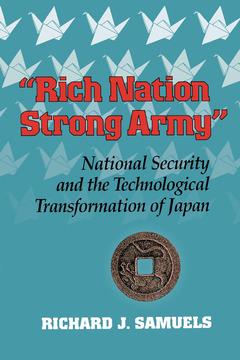
Since World War II, Japan has become not only a model producer of high-tech consumer goods, but also-despite minimal spending on defense-a leader in innovative technology with both military and civilian uses. In the United States, nearly one in every three scientists and engineers was engaged in defense-related research and development at the end of the Cold War, but the relative strength of the American economy has declined in recent years.
What is the relationship between what has happened in the two countries? And where did Japan's technological excellence come from? In an economic history that will arouse controversy on both sides of the Pacific, Richard J. Samuels finds a key to Japan's success in an ideology of technological development that advances national interests.
From 1868 until 1945, the Japanese economy was fired by the development of technology to enhance national security; the rallying cry "Rich Nation, Strong Army" accompanied the expanded military spending and aggressive foreign policy that led to the disasters of the War in the Pacific. Postwar economic planners reversed the assumptions that had driven Japan's industrialization, Samuels shows, promoting instead the development of commercial technology and infrastructure. By valuing process improvements as much as product innovation, the modern Japanese system has built up the national capacity to innovate while ensuring that technological advances have been diffused broadly through industries such as aerospace that have both civilian and military applications.
Struggling with the uncertainties of a post-Cold War economy, the United States has important lessons to learn from the way Japan has subordinated defense production yet emerged as one of the most technologically sophisticated nations in the world. The Japanese, like the Venetians and the Dutch before them, show us that butter is just as likely as guns to make a nation strong, but that nations cannot hope to be strong without an ideology of technological development that nourishes the entire national economy.
Before Memmo my notes were scattered across PDFs. Now a workspace pulls everything into one place — I see exactly what's still left to study.
Memmo's summaries are gold before exams. I don't have to re-read 800 pages two weeks before — just the important parts.
The AI chat has saved me the night before an exam more than once. I just keep asking until I get it — no waiting on a study group to reply.
The quizzes hit exactly what I need to know. Memmo tracks what I get stuck on — so I only practice what's worth it.
Flashcards with spaced repetition are magic. Memmo knows when I'm about to forget something and brings it back.
The AI podcasts are my favorite. I listen on my way to school and get a recap without sitting at a computer.

Handbok i kvalitativa metoder
281 kr

Hållbar utveckling: en introduktion för ingenjörer och andra problemlösare
334 kr

Brymans Samhällsvetenskapliga metoder
390 kr

Projektledning
491 kr

Den orättvisa hälsan: om socioekonomiska skillnader i hälsa och livslängd
326 kr

Vetenskapsteori för nybörjare
196 kr

Organizational Leadership
429 kr

På väg mot läraryrket
172 kr

Det sociala livet i skolan: Socialpsykologiska perspektiv
253 kr

Betygsättningens didaktik
151 kr

Personality
402 kr

Studying Leadership
404 kr

Managing Innovation
477 kr

Introduktion till samhällsvetenskaplig metod
347 kr

The Psychology of Sex and Gender
698 kr

Evidens och kunskap för socialt arbete
207 kr

Introduction to Leadership
605 kr