
Before Memmo my notes were scattered across PDFs. Now a workspace pulls everything into one place — I see exactly what's still left to study.
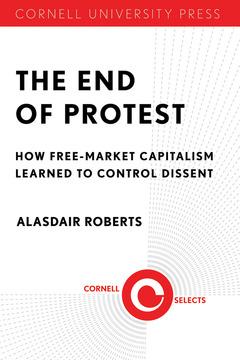
The United States has just gone through the worst economic crisis in a generation. Why wasn't there more protest, as there was in other countries? During the United States' last great era of free-market policies, before World War II, economic crises were always accompanied by unrest. "The history of capitalism," the economist Joseph Schumpeter warned in 1942, "is studded with violent bursts and catastrophes." In The End of Protest, Alasdair Roberts explains how, in the modern age, governments learned to unleash market forces while also avoiding protest about the market's failures.
Roberts argues that in the last three decades, the two countries that led the free-market revolution—the United States and Britain—have invented new strategies for dealing with unrest over free market policies. The organizing capacity of unions has been undermined so that it is harder to mobilize discontent. The mobilizing potential of new information technologies has also been checked. Police forces are bigger and better equipped than ever before. And technocrats in central banks have been given unprecedented power to avoid full-scale economic calamities.
Tracing the histories of economic unrest in the United States and Great Britain from the nineteenth century to the present, The End of Protest shows that governments have always been preoccupied with the task of controlling dissent over free market policies. But today's methods pose a new threat to democratic values. For the moment, advocates of free-market capitalism have found ways of controlling discontent, but the continued effectiveness of these strategies is by no means certain.
Before Memmo my notes were scattered across PDFs. Now a workspace pulls everything into one place — I see exactly what's still left to study.
Memmo's summaries are gold before exams. I don't have to re-read 800 pages two weeks before — just the important parts.
The AI chat has saved me the night before an exam more than once. I just keep asking until I get it — no waiting on a study group to reply.
The quizzes hit exactly what I need to know. Memmo tracks what I get stuck on — so I only practice what's worth it.
Flashcards with spaced repetition are magic. Memmo knows when I'm about to forget something and brings it back.
The AI podcasts are my favorite. I listen on my way to school and get a recap without sitting at a computer.

Handbok i kvalitativa metoder
281 kr

Hållbar utveckling: en introduktion för ingenjörer och andra problemlösare
334 kr

Brymans Samhällsvetenskapliga metoder
390 kr

Projektledning
491 kr

Den orättvisa hälsan: om socioekonomiska skillnader i hälsa och livslängd
326 kr

Vetenskapsteori för nybörjare
196 kr

Organizational Leadership
429 kr

På väg mot läraryrket
172 kr

Det sociala livet i skolan: Socialpsykologiska perspektiv
253 kr

Betygsättningens didaktik
151 kr

Personality
402 kr

Studying Leadership
404 kr

Managing Innovation
477 kr

Introduktion till samhällsvetenskaplig metod
347 kr

The Psychology of Sex and Gender
698 kr

Evidens och kunskap för socialt arbete
207 kr

Introduction to Leadership
605 kr