
Before Memmo my notes were scattered across PDFs. Now a workspace pulls everything into one place — I see exactly what's still left to study.
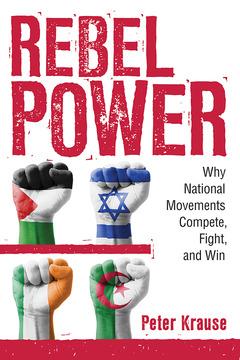
Many of the world's states—from Algeria to Ireland to the United States—are the result of robust national movements that achieved independence. Many other national movements have failed in their attempts to achieve statehood, including the Basques, the Kurds, and the Palestinians. In Rebel Power, Peter Krause offers a powerful new theory to explain this variation focusing on the internal balance of power among nationalist groups, who cooperate with each other to establish a new state while simultaneously competing to lead it. The most powerful groups push to achieve states while they are in position to rule them, whereas weaker groups unlikely to gain the spoils of office are likely to become spoilers, employing risky, escalatory violence to forestall victory while they improve their position in the movement hierarchy. Hegemonic movements with one dominant group are therefore more likely to achieve statehood than internally competitive, fragmented movements due to their greater pursuit of victory and lesser use of counterproductive violence.
Krause conducted years of fieldwork in government and nationalist group archives in the Middle East, North Africa, and Europe, as well as more than 150 interviews with participants in the Palestinian, Zionist, Algerian, and Irish national movements. This research generated comparative longitudinal analyses of these four national movements involving 40 groups in 44 campaigns over a combined 140 years of struggle. Krause identifies new turning points in the history of these movements and provides fresh explanations for their use of violent and nonviolent strategies, as well as their numerous successes and failures. Rebel Power is essential reading for understanding not only the history of national movements but also the causes and consequences of contentious collective action today, from the Arab Spring to the civil wars and insurgencies in Syria, Afghanistan, Iraq, and beyond.
Before Memmo my notes were scattered across PDFs. Now a workspace pulls everything into one place — I see exactly what's still left to study.
Memmo's summaries are gold before exams. I don't have to re-read 800 pages two weeks before — just the important parts.
The AI chat has saved me the night before an exam more than once. I just keep asking until I get it — no waiting on a study group to reply.
The quizzes hit exactly what I need to know. Memmo tracks what I get stuck on — so I only practice what's worth it.
Flashcards with spaced repetition are magic. Memmo knows when I'm about to forget something and brings it back.
The AI podcasts are my favorite. I listen on my way to school and get a recap without sitting at a computer.

Handbok i kvalitativa metoder
281 kr

Hållbar utveckling: en introduktion för ingenjörer och andra problemlösare
334 kr

Brymans Samhällsvetenskapliga metoder
390 kr

Projektledning
491 kr

Den orättvisa hälsan: om socioekonomiska skillnader i hälsa och livslängd
326 kr

Vetenskapsteori för nybörjare
196 kr

Organizational Leadership
429 kr

På väg mot läraryrket
172 kr

Det sociala livet i skolan: Socialpsykologiska perspektiv
253 kr

Betygsättningens didaktik
151 kr

Personality
402 kr

Studying Leadership
404 kr

Managing Innovation
477 kr

Introduktion till samhällsvetenskaplig metod
347 kr

The Psychology of Sex and Gender
698 kr

Evidens och kunskap för socialt arbete
207 kr

Introduction to Leadership
605 kr