
Before Memmo my notes were scattered across PDFs. Now a workspace pulls everything into one place — I see exactly what's still left to study.
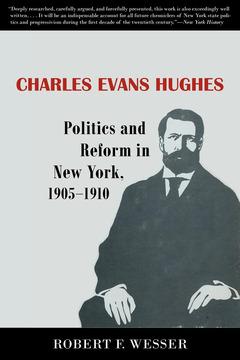
When Charles Evans Hughes defeated William Randolph Hearst for the governorship of New York in 1906, the New York State Republican Party was split between the remnants of the rural, conservative Platt political machine in Albany and the forces loyal to the progressive, energetic President and former New York Governor, Teddy Roosevelt. Although Hughes owed his nomination largely to Roosevelt's desire to weaken conservative influences, the aloof and independent governor's moral idealism and legal experience led him to positions more liberal and unyielding than even Roosevelt could endorse.
In this thorough study of Hughes's two terms as governor, Robert F. Wesser depicts the tensions of conservativism and liberalism, corruption and moral indignation, which rent the state government under his administration. Making use of unpublished manuscript collections, both personal and organizational, and other primary sources, Wesser evaluates the strengths and weaknesses of Hughes as a political leader and reformer. He shows that despite opposition from his own party, Hughes's governorship produced important reform legislation in three areas: improvement of the machinery and processes of government; extension of the state's regulatory authority over businesses engaged in public services; and expansion of governmental police and welfare functions. These legislative achievements were supplemented by Hughes's relentless dedication to administrative efficiency, which helped shift the focus of New York politics from the legislature and party organization to the office of the governor.
But not all Governor Hughes's efforts were successful, and Wesser carefully analyzes his failures as well as his triumphs-including the humiliating defeat at the hands of his own party's bosses in his quest to pass a direct primary voting bill-providing a complete portrait of a significant turning point in the history of New York and of the man who undermined some of the very foundations of the old political order. First published in 1967, Charles Evans Hughes remains an import work of scholarship on the history of New York and of the Progressive Era more broadly.
Before Memmo my notes were scattered across PDFs. Now a workspace pulls everything into one place — I see exactly what's still left to study.
Memmo's summaries are gold before exams. I don't have to re-read 800 pages two weeks before — just the important parts.
The AI chat has saved me the night before an exam more than once. I just keep asking until I get it — no waiting on a study group to reply.
The quizzes hit exactly what I need to know. Memmo tracks what I get stuck on — so I only practice what's worth it.
Flashcards with spaced repetition are magic. Memmo knows when I'm about to forget something and brings it back.
The AI podcasts are my favorite. I listen on my way to school and get a recap without sitting at a computer.

Handbok i kvalitativa metoder
281 kr

Hållbar utveckling: en introduktion för ingenjörer och andra problemlösare
334 kr

Brymans Samhällsvetenskapliga metoder
390 kr

Projektledning
491 kr

Den orättvisa hälsan: om socioekonomiska skillnader i hälsa och livslängd
326 kr

Organizational Leadership
429 kr

Vetenskapsteori för nybörjare
196 kr

På väg mot läraryrket
172 kr

Det sociala livet i skolan: Socialpsykologiska perspektiv
253 kr

Betygsättningens didaktik
151 kr

Personality
402 kr

Studying Leadership
404 kr

Managing Innovation
477 kr

Introduktion till samhällsvetenskaplig metod
347 kr

The Psychology of Sex and Gender
698 kr

Evidens och kunskap för socialt arbete
207 kr

Introduction to Leadership
605 kr