
Before Memmo my notes were scattered across PDFs. Now a workspace pulls everything into one place — I see exactly what's still left to study.
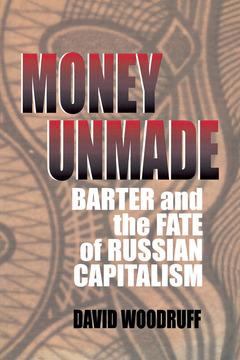
Since the collapse of the Soviet Union, Russians have seen the ruble steadily lose ground to alternative means of payment such as barter and privately issued quasi-monies. Industry now collects as much as 70 percent of its receipts in nonmonetary form, leaving many firms with too little cash to pay salaries and taxes. In this ground-breaking book on the Russian economy, David Woodruff argues that Moscow's inability to control the nation's currency is not a carry-over from the Soviet past. Rather, the Russian government has failed to build the administrative capacity and political support demanded by monetary consolidation—a neglected but crucial aspect of capitalist statebuilding.
Drawing on a vast array of empirical evidence, Woodruff shows how the widespread use of barter arose as local authorities tried to protect industry against the destructive effects of price increases and crude tax and accounting systems. As businesses fled or were driven from the money economy, provincial governments invented new ways to tax in kind and issued substitutes for the ruble. In turn, the federal authorities, unable to coerce firms either to operate in the money economy or to abandon business altogether, were forced to make accommodations to barter and to ruble alternatives. Woodruff describes the enormous fiscal difficulties that resulted and recounts the intense political battles over attempts to address the problem.
Through an overview of monetary consolidation in other nations, Woodruff demonstrates that the struggles of the new Russian state have much to teach us about the political history of money worldwide. Sovereignty over money cannot, he argues, be imposed by government on a recalcitrant society. Nor can it be assumed as a by-product of disciplined policies aimed at market reform. Monetary consolidation is, at heart, a political achievement requiring political support.
Before Memmo my notes were scattered across PDFs. Now a workspace pulls everything into one place — I see exactly what's still left to study.
Memmo's summaries are gold before exams. I don't have to re-read 800 pages two weeks before — just the important parts.
The AI chat has saved me the night before an exam more than once. I just keep asking until I get it — no waiting on a study group to reply.
The quizzes hit exactly what I need to know. Memmo tracks what I get stuck on — so I only practice what's worth it.
Flashcards with spaced repetition are magic. Memmo knows when I'm about to forget something and brings it back.
The AI podcasts are my favorite. I listen on my way to school and get a recap without sitting at a computer.

Handbok i kvalitativa metoder
281 kr

Hållbar utveckling: en introduktion för ingenjörer och andra problemlösare
334 kr

Brymans Samhällsvetenskapliga metoder
390 kr

Projektledning
491 kr

Den orättvisa hälsan: om socioekonomiska skillnader i hälsa och livslängd
326 kr

Organizational Leadership
429 kr

Vetenskapsteori för nybörjare
196 kr

På väg mot läraryrket
172 kr

Det sociala livet i skolan: Socialpsykologiska perspektiv
253 kr

Betygsättningens didaktik
151 kr

Personality
402 kr

Studying Leadership
404 kr

Managing Innovation
477 kr

Introduktion till samhällsvetenskaplig metod
347 kr

The Psychology of Sex and Gender
698 kr

Evidens och kunskap för socialt arbete
207 kr

Introduction to Leadership
605 kr