
Before Memmo my notes were scattered across PDFs. Now a workspace pulls everything into one place — I see exactly what's still left to study.
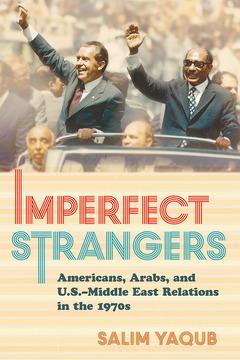
In Imperfect Strangers, Salim Yaqub argues that the 1970s were a pivotal decade for U.S.-Arab relations, whether at the upper levels of diplomacy, in street-level interactions, or in the realm of the imagination. In those years, Americans and Arabs came to know each other as never before. With Western Europe's imperial legacy fading in the Middle East, American commerce and investment spread throughout the Arab world. The United States strengthened its strategic ties to some Arab states, even as it drew closer to Israel. Maneuvering Moscow to the sidelines, Washington placed itself at the center of Arab-Israeli diplomacy. Meanwhile, the rise of international terrorism, the Arab oil embargo and related increases in the price of oil, and expanding immigration from the Middle East forced Americans to pay closer attention to the Arab world.
Yaqub combines insights from diplomatic, political, cultural, and immigration history to chronicle the activities of a wide array of American and Arab actors—political leaders, diplomats, warriors, activists, scholars, businesspeople, novelists, and others. He shows that growing interdependence raised hopes for a broad political accommodation between the two societies. Yet a series of disruptions in the second half of the decade thwarted such prospects. Arabs recoiled from a U.S.-brokered peace process that fortified Israel's occupation of Arab land. Americans grew increasingly resentful of Arab oil pressures, attitudes dovetailing with broader anti-Muslim sentiments aroused by the Iranian hostage crisis. At the same time, elements of the U.S. intelligentsia became more respectful of Arab perspectives as a newly assertive Arab American community emerged into political life. These patterns left a contradictory legacy of estrangement and accommodation that continued in later decades and remains with us today.
Before Memmo my notes were scattered across PDFs. Now a workspace pulls everything into one place — I see exactly what's still left to study.
Memmo's summaries are gold before exams. I don't have to re-read 800 pages two weeks before — just the important parts.
The AI chat has saved me the night before an exam more than once. I just keep asking until I get it — no waiting on a study group to reply.
The quizzes hit exactly what I need to know. Memmo tracks what I get stuck on — so I only practice what's worth it.
Flashcards with spaced repetition are magic. Memmo knows when I'm about to forget something and brings it back.
The AI podcasts are my favorite. I listen on my way to school and get a recap without sitting at a computer.

Handbok i kvalitativa metoder
281 kr

Hållbar utveckling: en introduktion för ingenjörer och andra problemlösare
334 kr

Brymans Samhällsvetenskapliga metoder
390 kr

Projektledning
491 kr

Den orättvisa hälsan: om socioekonomiska skillnader i hälsa och livslängd
326 kr

Vetenskapsteori för nybörjare
196 kr

Organizational Leadership
429 kr

På väg mot läraryrket
172 kr

Det sociala livet i skolan: Socialpsykologiska perspektiv
253 kr

Betygsättningens didaktik
151 kr

Personality
402 kr

Studying Leadership
404 kr

Managing Innovation
477 kr

Introduktion till samhällsvetenskaplig metod
347 kr

The Psychology of Sex and Gender
698 kr

Evidens och kunskap för socialt arbete
207 kr

Introduction to Leadership
605 kr