
Before Memmo my notes were scattered across PDFs. Now a workspace pulls everything into one place — I see exactly what's still left to study.
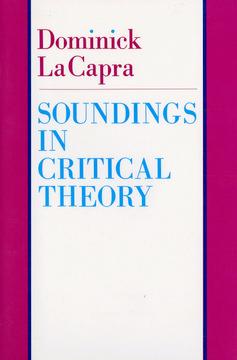
In Soundings in Critical Theory, Dominick LaCapra continues his attempt to fashion a historiography that is at once critical and self-critical—a project he initiated in Rethinking Intellectual History: Texts, Contexts, Language (1983); and History and Criticism (1985), both available from Cornell University Press. This new collection of essays offers a provocative assessment of the nature of historical understanding and the role of critical theory in historical understanding; of the practice of historical writing as a dialogic exchange both with the past and among professional historians and critics; and of the problem of how to read texts and documents in relation to processes of contextual understanding.
A central concern of the volume is the interaction between Marxism, psychoanalysis, and postmodernism, and all of the essays demonstrate the complex ways in which this trio of critical theories continues to affect how historians frame their task. LaCapra first provides a general appraisal of the problems and possibilities of criticism as a genre that questions its own limits, and examines the roles of Jacques Derrida, Michel Foucault, Jean-François Lyotard, and Mikhail Bakhtin in the development of contemporary criticism. Subsequent chapters address such issues as the implications of psychoanalysis for the writing of history, the debate between Robert Darnton and Roger Chartier concerning the status of the symbolic dimension in history, and the problem of how best to read and make use of Marx's work. LaCapra concludes by exploring the larger project of forging viable links between history and critical theory and by evaluating the contributions of deconstruction and the new historicism to this project.
Contemporary cultural and intellectual historians, literary theorists and critics, philosophers, and social scientists will welcome this book.
Before Memmo my notes were scattered across PDFs. Now a workspace pulls everything into one place — I see exactly what's still left to study.
Memmo's summaries are gold before exams. I don't have to re-read 800 pages two weeks before — just the important parts.
The AI chat has saved me the night before an exam more than once. I just keep asking until I get it — no waiting on a study group to reply.
The quizzes hit exactly what I need to know. Memmo tracks what I get stuck on — so I only practice what's worth it.
Flashcards with spaced repetition are magic. Memmo knows when I'm about to forget something and brings it back.
The AI podcasts are my favorite. I listen on my way to school and get a recap without sitting at a computer.

Handbok i kvalitativa metoder
281 kr

Hållbar utveckling: en introduktion för ingenjörer och andra problemlösare
334 kr

Brymans Samhällsvetenskapliga metoder
390 kr

Projektledning
491 kr

Den orättvisa hälsan: om socioekonomiska skillnader i hälsa och livslängd
326 kr

Vetenskapsteori för nybörjare
196 kr

Organizational Leadership
429 kr

På väg mot läraryrket
172 kr

Det sociala livet i skolan: Socialpsykologiska perspektiv
253 kr

Betygsättningens didaktik
151 kr

Personality
402 kr

Studying Leadership
404 kr

Managing Innovation
477 kr

Introduktion till samhällsvetenskaplig metod
347 kr

The Psychology of Sex and Gender
698 kr

Evidens och kunskap för socialt arbete
207 kr

Introduction to Leadership
605 kr