
Before Memmo my notes were scattered across PDFs. Now a workspace pulls everything into one place — I see exactly what's still left to study.
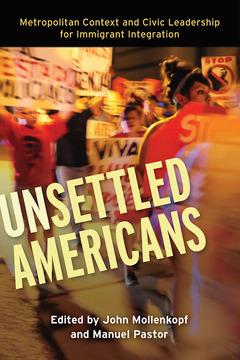
The politics of immigration have heated up in recent years as Congress has failed to adopt comprehensive immigration reform, the President has proposed executive actions, and state and local governments have responded unevenly and ambivalently to burgeoning immigrant communities in the context of a severe economic downturn. Moreover we have witnessed large shifts in the locations of immigrants and their families between and within the metropolitan areas of the United States. Charlotte, North Carolina, may be a more active and dynamic immigrant destination than Chicago, Illinois, while the suburbs are receiving ever more immigrants.
The work of John Mollenkopf, Manuel Pastor, and their colleagues represents one of the first systematic comparative studies of immigrant incorporation at the metropolitan level. They consider immigrant reception in seven different metro areas, and their analyses stress the differences in capacity and response between central cities, down-at-the-heels suburbs, and outer metropolitan areas, as well as across metro areas. A key feature of case studies in the book is their inclusion of not only traditional receiving areas (New York, Chicago, and Los Angeles) but also newer ones (Charlotte, Phoenix, San Jose, and California's "Inland Empire"). Another innovative aspect is that the authors link their work to the new literature on regional governance, contribute to emerging research on spatial variations within metropolitan areas, and highlight points of intersection with the longer-term processes of immigrant integration.
Contributors: Els de Graauw, CUNY; Juan De Lara, University of Southern California; Jaime Dominguez, Northwestern University; Diana Gordon, CUNY; Michael Jones-Correa, Cornell University; Paul Lewis, Arizona State University; Doris Marie Provine, Arizona State University; John Mollenkopf, CUNY; Manuel Pastor, University of Southern California; Rachel Rosner, independent consultant, Florida; Jennifer Tran, City of San Francisco
Before Memmo my notes were scattered across PDFs. Now a workspace pulls everything into one place — I see exactly what's still left to study.
Memmo's summaries are gold before exams. I don't have to re-read 800 pages two weeks before — just the important parts.
The AI chat has saved me the night before an exam more than once. I just keep asking until I get it — no waiting on a study group to reply.
The quizzes hit exactly what I need to know. Memmo tracks what I get stuck on — so I only practice what's worth it.
Flashcards with spaced repetition are magic. Memmo knows when I'm about to forget something and brings it back.
The AI podcasts are my favorite. I listen on my way to school and get a recap without sitting at a computer.

Handbok i kvalitativa metoder
281 kr

Hållbar utveckling: en introduktion för ingenjörer och andra problemlösare
334 kr

Brymans Samhällsvetenskapliga metoder
390 kr

Projektledning
491 kr

Den orättvisa hälsan: om socioekonomiska skillnader i hälsa och livslängd
326 kr

Vetenskapsteori för nybörjare
196 kr

Organizational Leadership
429 kr

På väg mot läraryrket
172 kr

Det sociala livet i skolan: Socialpsykologiska perspektiv
253 kr

Betygsättningens didaktik
151 kr

Personality
402 kr

Studying Leadership
404 kr

Managing Innovation
477 kr

Introduktion till samhällsvetenskaplig metod
347 kr

The Psychology of Sex and Gender
698 kr

Evidens och kunskap för socialt arbete
207 kr

Introduction to Leadership
605 kr