
Before Memmo my notes were scattered across PDFs. Now a workspace pulls everything into one place — I see exactly what's still left to study.
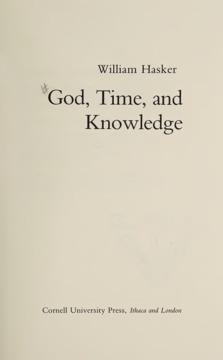
In God, Time, and Knowledge, William Hasker explores the major issues concerning God's knowledge of the future in relation to time and human freedom: divine foreknowledge, middle knowledge, and divine timelessness. Although he focuses on discussions that have taken place within analytic philosophy in the last thirty years, Hasker also places the issues within the context of the history of philosophical and theological reflection on these matters.
Proceeding from a libertarian standpoint, Hasker begins by providing a series of arguments against the possibility of middle knowledge. He next considers and rejects all of the major methods by which the compatibility of foreknowledge and freedom have been defended: the contention that facts about God's past beliefs are soft (or relational) facts about the past, the claim that we have counterfactual power over the past, and the belief that we have the power to bring about or even cause past events. Hasker then carefully examines the notion of God as timelessly eternal and finds it provisionally intelligible; nevertheless, he charges that the doctrine of divine timelessness is inadequately motivated apart from the Augustinian-Neoplatonic metaphysics that was its historical source. He concludes by arguing for a view according to which the future is open and divine providence involves risk-taking.
Lucidly and engagingly written, God, Time, and Knowledge is a significant contribution to the contemporary debate over freedom and foreknowledge. It will generate discussion and controversy among philosophers of religion, metaphysicians, and theologians.
Before Memmo my notes were scattered across PDFs. Now a workspace pulls everything into one place — I see exactly what's still left to study.
Memmo's summaries are gold before exams. I don't have to re-read 800 pages two weeks before — just the important parts.
The AI chat has saved me the night before an exam more than once. I just keep asking until I get it — no waiting on a study group to reply.
The quizzes hit exactly what I need to know. Memmo tracks what I get stuck on — so I only practice what's worth it.
Flashcards with spaced repetition are magic. Memmo knows when I'm about to forget something and brings it back.
The AI podcasts are my favorite. I listen on my way to school and get a recap without sitting at a computer.

Handbok i kvalitativa metoder
281 kr

Hållbar utveckling: en introduktion för ingenjörer och andra problemlösare
334 kr

Brymans Samhällsvetenskapliga metoder
390 kr

Projektledning
491 kr

Den orättvisa hälsan: om socioekonomiska skillnader i hälsa och livslängd
326 kr

Vetenskapsteori för nybörjare
196 kr

Organizational Leadership
429 kr

På väg mot läraryrket
172 kr

Det sociala livet i skolan: Socialpsykologiska perspektiv
253 kr

Betygsättningens didaktik
151 kr

Personality
402 kr

Studying Leadership
404 kr

Managing Innovation
477 kr

Introduktion till samhällsvetenskaplig metod
347 kr

The Psychology of Sex and Gender
698 kr

Evidens och kunskap för socialt arbete
207 kr

Introduction to Leadership
605 kr