
Before Memmo my notes were scattered across PDFs. Now a workspace pulls everything into one place — I see exactly what's still left to study.
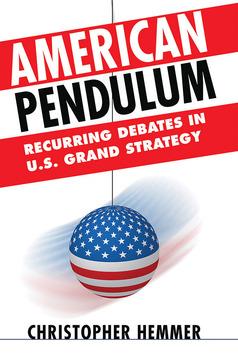
As new presidential administrations come into power, they each bring their own approach to foreign policy. No grand strategy, however, is going to be completely novel. New administrations never start with a blank slate, so it is always possible to see similarities between an administration and its predecessors. Conversely, since each administration faces novel problems and operates in a unique context, no foreign policy strategy is going to be an exact replica of its predecessors.
In American Pendulum, Christopher Hemmer examines America's grand strategic choices between 1914 and 2014 using four recurring debates in American foreign policy as lenses. First, how should the United States balance the trade-offs between working alone versus working with other states and international organizations? Second, what is the proper place of American values in foreign policy? Third, where does the strategic perimeter of the United States lie? And fourth, is time on the side of the United States or of its enemies?
Offering new readings of debates within the Wilson, Truman, Nixon, Bush, and Obama administrations, Hemmer asserts that heated debates, disagreements, and even confusions over U.S. grand strategy are not only normal but also beneficial. He challenges the claim that uncertainties or inconsistences about the nation's role in the world or approach to security issues betray strategic confusion or the absence of a grand strategy. American foreign policy, he states, is most in danger not when debates are at their most pointed but when the weight of opinion crushes dissent.
As the United States looks ahead to an increasingly multipolar world with increasing complicated security issues, Hemmer concludes, developing an effective grand strategy requires ongoing contestation and compromises between competing visions and policies.
Before Memmo my notes were scattered across PDFs. Now a workspace pulls everything into one place — I see exactly what's still left to study.
Memmo's summaries are gold before exams. I don't have to re-read 800 pages two weeks before — just the important parts.
The AI chat has saved me the night before an exam more than once. I just keep asking until I get it — no waiting on a study group to reply.
The quizzes hit exactly what I need to know. Memmo tracks what I get stuck on — so I only practice what's worth it.
Flashcards with spaced repetition are magic. Memmo knows when I'm about to forget something and brings it back.
The AI podcasts are my favorite. I listen on my way to school and get a recap without sitting at a computer.

Handbok i kvalitativa metoder
281 kr

Hållbar utveckling: en introduktion för ingenjörer och andra problemlösare
334 kr

Brymans Samhällsvetenskapliga metoder
390 kr

Projektledning
491 kr

Den orättvisa hälsan: om socioekonomiska skillnader i hälsa och livslängd
326 kr

Vetenskapsteori för nybörjare
196 kr

Organizational Leadership
429 kr

På väg mot läraryrket
172 kr

Det sociala livet i skolan: Socialpsykologiska perspektiv
253 kr

Betygsättningens didaktik
151 kr

Personality
402 kr

Studying Leadership
404 kr

Managing Innovation
477 kr

Introduktion till samhällsvetenskaplig metod
347 kr

The Psychology of Sex and Gender
698 kr

Evidens och kunskap för socialt arbete
207 kr

Introduction to Leadership
605 kr