
Before Memmo my notes were scattered across PDFs. Now a workspace pulls everything into one place — I see exactly what's still left to study.
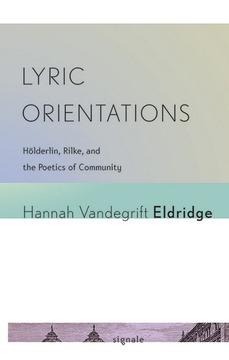
In Lyric Orientations, Hannah Vandegrift Eldridge explores the power of lyric poetry to stir the social and emotional lives of human beings in the face of the ineffable nature of our mortality. She focuses on two German-speaking masters of lyric prose and poetry: Friedrich Hölderlin (1770–1843) and Rainer Maria Rilke (1875–1926). While Hölderlin and Rilke are stylistically very different, each believes in the power of poetic language to orient us as social beings in contexts that otherwise can be alienating. They likewise share the conviction that such alienation cannot be overcome once and for all in any universal event. Both argue that to deny the uncertainty created by the absence of any such event (or to deny the alienation itself) is likewise to deny the particularly human condition of uncertainty and mortality.
By drawing on the work of Stanley Cavell, who explores how language in all its formal aspects actually enables us to engage meaningfully with the world, Eldridge challenges poststructuralist scholarship, which stresses the limitations—even the failure—of language in the face of reality. Eldridge provides detailed readings of Hölderlin and Rilke and positions them in a broader narrative of modernity that helps make sense of their difficult and occasionally contradictory self-characterizations. Her account of the orienting and engaging capabilities of language reconciles the extraordinarily ambitious claims that Hölderlin and Rilke make for poetry—that it can create political communities, that it can change how humans relate to death, and that it can unite the sensual and intellectual components of human subjectivity—and the often difficult, fragmented, or hermetic nature of their individual poems.
Before Memmo my notes were scattered across PDFs. Now a workspace pulls everything into one place — I see exactly what's still left to study.
Memmo's summaries are gold before exams. I don't have to re-read 800 pages two weeks before — just the important parts.
The AI chat has saved me the night before an exam more than once. I just keep asking until I get it — no waiting on a study group to reply.
The quizzes hit exactly what I need to know. Memmo tracks what I get stuck on — so I only practice what's worth it.
Flashcards with spaced repetition are magic. Memmo knows when I'm about to forget something and brings it back.
The AI podcasts are my favorite. I listen on my way to school and get a recap without sitting at a computer.

Handbok i kvalitativa metoder
281 kr

Hållbar utveckling: en introduktion för ingenjörer och andra problemlösare
334 kr

Brymans Samhällsvetenskapliga metoder
390 kr

Projektledning
491 kr

Den orättvisa hälsan: om socioekonomiska skillnader i hälsa och livslängd
326 kr

Vetenskapsteori för nybörjare
196 kr

Organizational Leadership
429 kr

På väg mot läraryrket
172 kr

Det sociala livet i skolan: Socialpsykologiska perspektiv
253 kr

Betygsättningens didaktik
151 kr

Personality
402 kr

Studying Leadership
404 kr

Managing Innovation
477 kr

Introduktion till samhällsvetenskaplig metod
347 kr

The Psychology of Sex and Gender
698 kr

Evidens och kunskap för socialt arbete
207 kr

Introduction to Leadership
605 kr