
Before Memmo my notes were scattered across PDFs. Now a workspace pulls everything into one place — I see exactly what's still left to study.
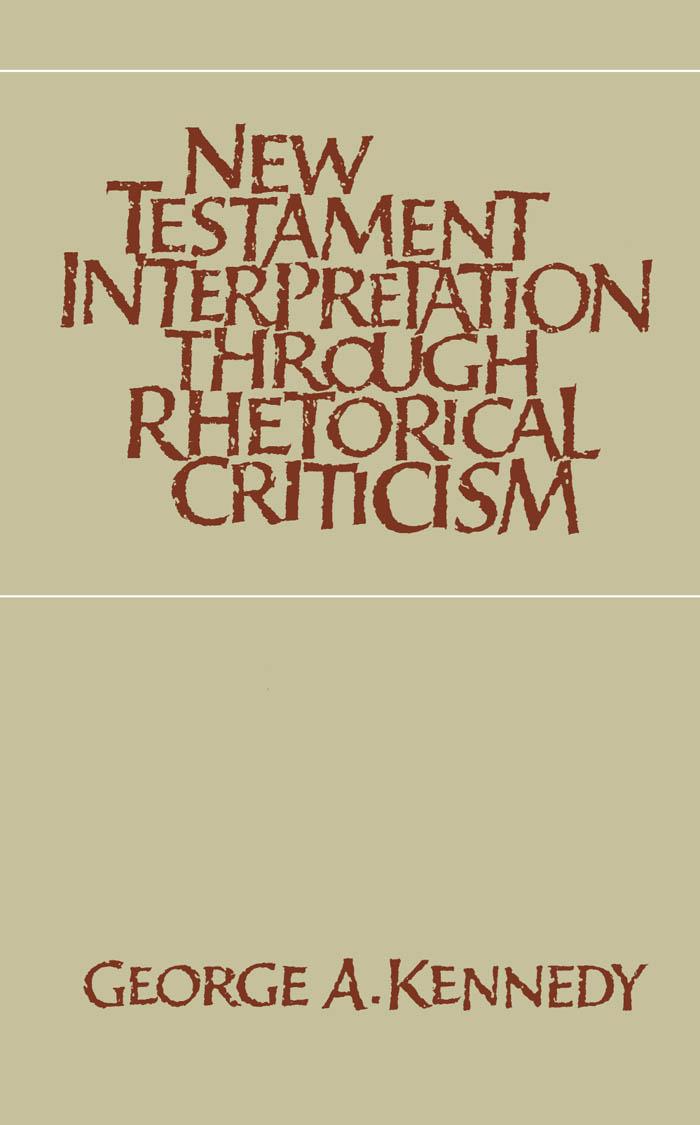
New Testament Interpretation through Rhetorical Criticism provides readers of the Bible with an important tool for understanding the Scriptures. Based on the theory and practice of Greek rhetoric in the New Testament, George Kennedy’s approach acknowledges that New Testament writers wrote to persuade an audience of the truth of their messages. These writers employed rhetorical conventions that were widely known and imitated in the society of the times. Sometimes confirming but often challenging common interpretations of texts, this is the first systematic study of the rhetorical composition of the New Testament.
As a complement to form criticism, historical criticism, and other methods of biblical analysis, rhetorical criticism focuses on the text as we have it and seeks to discover the basis of its powerful appeal and the intent of its authors. Kennedy shows that biblical writers employed both “external” modes of persuasion, such as scriptural authority, the evidence of miracles, and the testimony of witnesses, and “internal” methods, such as ethos (authority and character of the speaker), pathos (emotional appeal to the audience), and logos (deductive and inductive argument in the text).
In the opening chapter Kennedy presents a survey of how rhetoric was taught in the New Testament period and outlines a rigorous method of rhetorical criticism that involves a series of steps. He provides in succeeding chapters examples of rhetorical analysis, looking closely at the Sermon on the Mount, the Sermon on the Plain, Jesus' farewell to the disciples in John’s Gospel, the distinctive rhetoric of Jesus, the speeches in Acts, and the approach of Saint Paul in Second Corinthians, Thessalonians, Galatians, and Romans.
Before Memmo my notes were scattered across PDFs. Now a workspace pulls everything into one place — I see exactly what's still left to study.
Memmo's summaries are gold before exams. I don't have to re-read 800 pages two weeks before — just the important parts.
The AI chat has saved me the night before an exam more than once. I just keep asking until I get it — no waiting on a study group to reply.
The quizzes hit exactly what I need to know. Memmo tracks what I get stuck on — so I only practice what's worth it.
Flashcards with spaced repetition are magic. Memmo knows when I'm about to forget something and brings it back.
The AI podcasts are my favorite. I listen on my way to school and get a recap without sitting at a computer.

Handbok i kvalitativa metoder
281 kr

Hållbar utveckling: en introduktion för ingenjörer och andra problemlösare
334 kr

Brymans Samhällsvetenskapliga metoder
390 kr

Projektledning
491 kr

Den orättvisa hälsan: om socioekonomiska skillnader i hälsa och livslängd
326 kr

Vetenskapsteori för nybörjare
196 kr

Organizational Leadership
429 kr

På väg mot läraryrket
172 kr

Det sociala livet i skolan: Socialpsykologiska perspektiv
253 kr

Betygsättningens didaktik
151 kr

Personality
402 kr

Studying Leadership
404 kr

Managing Innovation
477 kr

Introduktion till samhällsvetenskaplig metod
347 kr

The Psychology of Sex and Gender
698 kr

Evidens och kunskap för socialt arbete
207 kr

Introduction to Leadership
605 kr