
Before Memmo my notes were scattered across PDFs. Now a workspace pulls everything into one place — I see exactly what's still left to study.
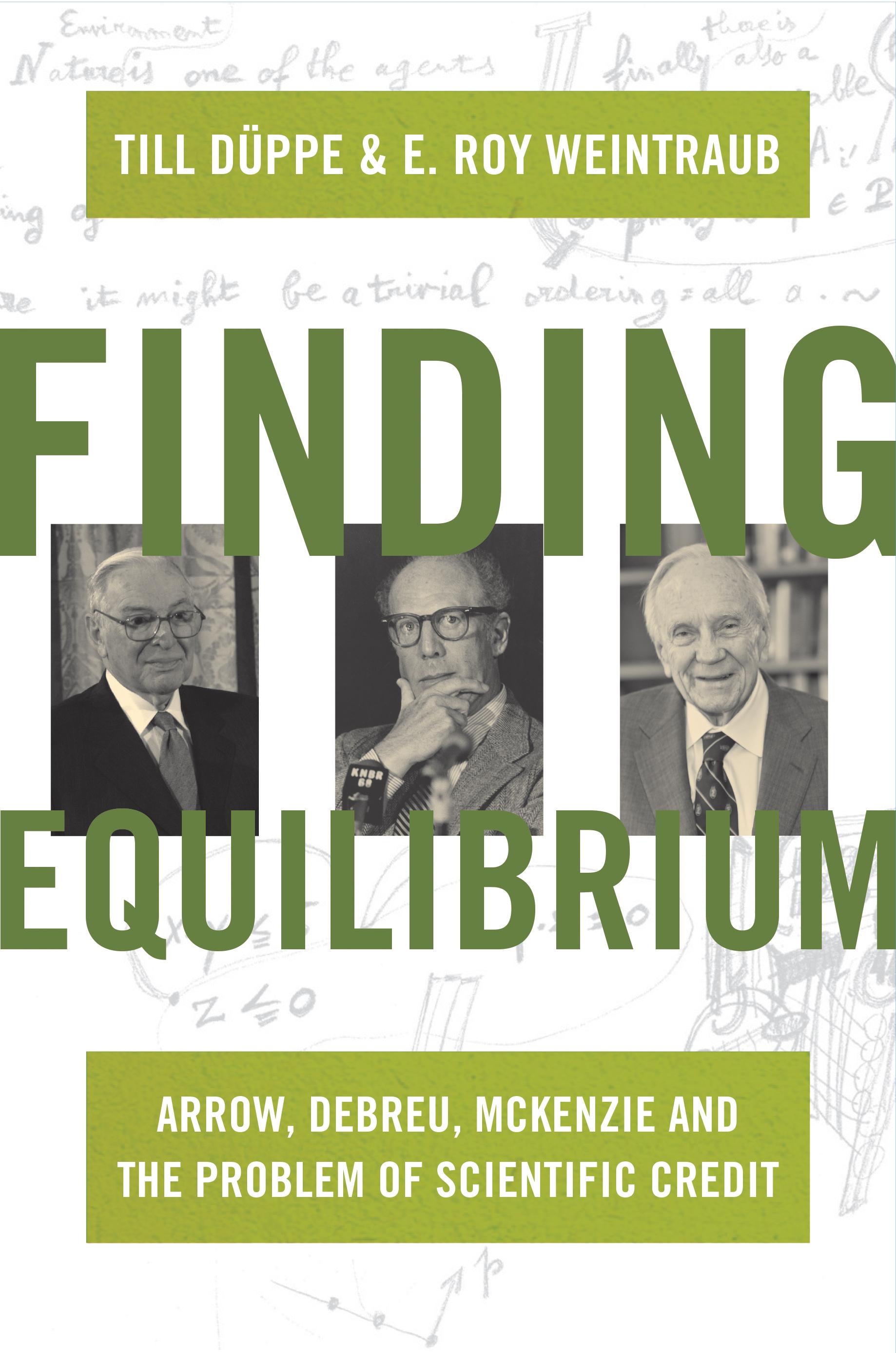
The remarkable story and personalities behind one of the most important theories in modern economics
Finding Equilibrium explores the post–World War II transformation of economics by constructing a history of the proof of its central dogma—that a competitive market economy may possess a set of equilibrium prices. The model economy for which the theorem could be proved was mapped out in 1954 by Kenneth Arrow and Gerard Debreu collaboratively, and by Lionel McKenzie separately, and would become widely known as the "Arrow-Debreu Model." While Arrow and Debreu would later go on to win separate Nobel prizes in economics, McKenzie would never receive it. Till Düppe and E. Roy Weintraub explore the lives and work of these economists and the issues of scientific credit against the extraordinary backdrop of overlapping research communities and an economics discipline that was shifting dramatically to mathematical modes of expression.
Based on recently opened archives, Finding Equilibrium shows the complex interplay between each man's personal life and work, and examines compelling ideas about scientific credit, publication, regard for different research institutions, and the awarding of Nobel prizes. Instead of asking whether recognition was rightly or wrongly given, and who were the heroes or villains, the book considers attitudes toward intellectual credit and strategies to gain it vis-à-vis the communities that grant it.
Telling the story behind the proof of the central theorem in economics, Finding Equilibrium sheds light on the changing nature of the scientific community and the critical connections between the personal and public rewards of scientific work.
Before Memmo my notes were scattered across PDFs. Now a workspace pulls everything into one place — I see exactly what's still left to study.
Memmo's summaries are gold before exams. I don't have to re-read 800 pages two weeks before — just the important parts.
The AI chat has saved me the night before an exam more than once. I just keep asking until I get it — no waiting on a study group to reply.
The quizzes hit exactly what I need to know. Memmo tracks what I get stuck on — so I only practice what's worth it.
Flashcards with spaced repetition are magic. Memmo knows when I'm about to forget something and brings it back.
The AI podcasts are my favorite. I listen on my way to school and get a recap without sitting at a computer.

Handbok i kvalitativa metoder
281 kr

Hållbar utveckling: en introduktion för ingenjörer och andra problemlösare
334 kr

Brymans Samhällsvetenskapliga metoder
390 kr

Projektledning
491 kr

Den orättvisa hälsan: om socioekonomiska skillnader i hälsa och livslängd
326 kr

Vetenskapsteori för nybörjare
196 kr

Organizational Leadership
429 kr

På väg mot läraryrket
172 kr

Det sociala livet i skolan: Socialpsykologiska perspektiv
253 kr

Betygsättningens didaktik
151 kr

Personality
402 kr

Studying Leadership
404 kr

Managing Innovation
477 kr

Introduktion till samhällsvetenskaplig metod
347 kr

The Psychology of Sex and Gender
698 kr

Evidens och kunskap för socialt arbete
207 kr

Introduction to Leadership
605 kr