
Before Memmo my notes were scattered across PDFs. Now a workspace pulls everything into one place — I see exactly what's still left to study.
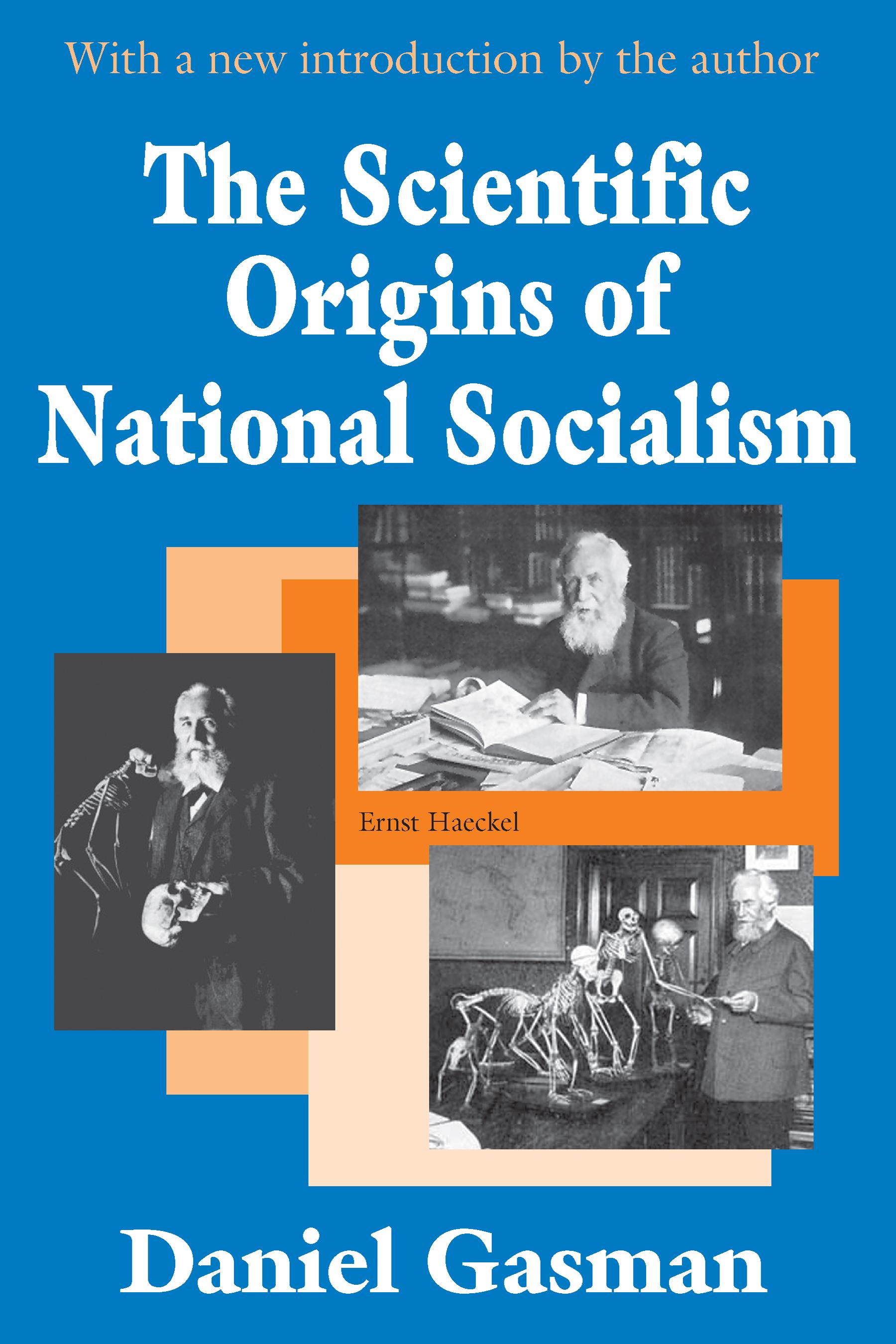
Many studies of the origins of National Socialism claim that the vo;lkisch and proto-Nazi movement arose largely as a reaction to the materialistic ideas of nineteenth-century science and especially to the naturalistic philosophy of Ernst Haeckel and the German Monist League. Using hitherto unexplored material, Daniel Gasman calls this generalization into question. Arguing that the importance of science has been relatively neglected in accounts of the intellectual origins of Nazism, he attempts to show that Haeckel's "scientific" Darwinism, and his movement, the German Monist League, were proto-Nazi in character.
Contrary to popular belief, Haeckel's type of social Darwinism actually played a critical role in the formation of National Socialist ideology. In his new introduction, Gasman notes that recent research goes far to confirm Haeckel's role as an ideological progenitor of fascist ideology. This is true not only for Germany, but also for the birth of fascist thought in Italy and France. In general, Gasman claims, the history of science plainly reveals how Haeckel's social Darwinism nourished the roots of fascism no less than avant-garde modernism.
When The Scientific Origins of National Socialism initially appeared, the Times Literary Supplement called it a "very well-argued thesis... that is completely successful... and leaves the reader to extract his own moral lessons." Medical History, in its review of The Scientific Origins of National Socialism, said, "His book is essential for understanding modern Germany. It has a general message derived from the events in Germany, where scientific data were permitted to take on a mystical signficiance... with ghastly consequences." Bruce Chatwin, in the New York Review of Books, called the book "brilliant." Now available in paperback, with a new introduction by the author, this seminal work will be of interest to intellectual historians, as well as th
Before Memmo my notes were scattered across PDFs. Now a workspace pulls everything into one place — I see exactly what's still left to study.
Memmo's summaries are gold before exams. I don't have to re-read 800 pages two weeks before — just the important parts.
The AI chat has saved me the night before an exam more than once. I just keep asking until I get it — no waiting on a study group to reply.
The quizzes hit exactly what I need to know. Memmo tracks what I get stuck on — so I only practice what's worth it.
Flashcards with spaced repetition are magic. Memmo knows when I'm about to forget something and brings it back.
The AI podcasts are my favorite. I listen on my way to school and get a recap without sitting at a computer.

Handbok i kvalitativa metoder
281 kr

Hållbar utveckling: en introduktion för ingenjörer och andra problemlösare
334 kr

Brymans Samhällsvetenskapliga metoder
390 kr

Projektledning
491 kr

Den orättvisa hälsan: om socioekonomiska skillnader i hälsa och livslängd
326 kr

Vetenskapsteori för nybörjare
196 kr

Organizational Leadership
429 kr

På väg mot läraryrket
172 kr

Det sociala livet i skolan: Socialpsykologiska perspektiv
253 kr

Betygsättningens didaktik
151 kr

Personality
402 kr

Studying Leadership
404 kr

Managing Innovation
477 kr

Introduktion till samhällsvetenskaplig metod
347 kr

The Psychology of Sex and Gender
698 kr

Evidens och kunskap för socialt arbete
207 kr

Introduction to Leadership
605 kr