
Before Memmo my notes were scattered across PDFs. Now a workspace pulls everything into one place — I see exactly what's still left to study.
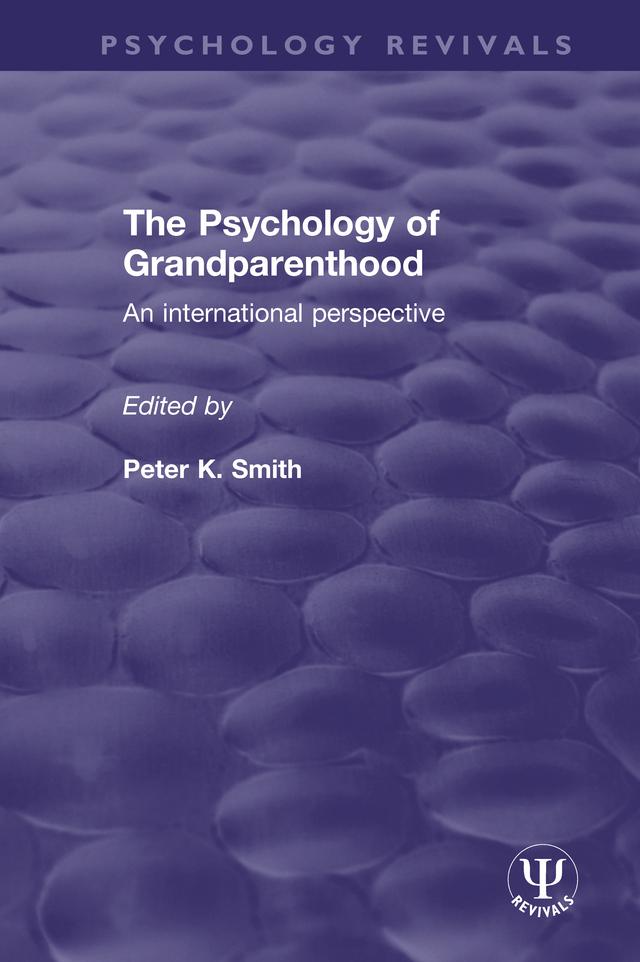
The majority of people will now spend about one-third of their lives as grandparents, yet developmental psychologists have largely ignored the nature of the grandparental role, and the influence which grandparents can have on grandchildren. Originally published in 1991, this book redresses the balance and uses life-span evolutionary and psychodynamic theoretical frameworks to provide a comprehensive analysis of the phenomenon of grandparenthood from cross-cultural perspectives.
Much recent work in developmental psychology has disregarded the extended family in favour of the two-generational nuclear family of parents and children. But grandparents do have a significant role in family relationships and children’s development. This volume contains detailed discussion of intergenerational transmission of parenting skills, cooperation and conflict in three-generational families and the ways in which grandparents and grandchildren perceive one another.
The importance of considering social and cultural contexts of development applies to grandparents just as much as to other areas of human development. Kinds of family structure, social policies regarding employment, health and housing, attitudes to marriage and even particular historical events all have an impact on the position and role of grandparents and on stereotypes of old age. These factors vary considerably from country to country. Our understanding of grandparenthood can only be enriched by learning about the variety of ways in which it is expressed in different cultural settings. Most previous research has been confined to the USA. This book is truly international containing contributions from Britain, Canada, Finland, Italy, the Netherlands, Poland, West Germany and the USA. International comparisons enable us to see which elements are essential to grandparenthood and which are culture dependant. In most Western countries the population is ageing and this sort of study is becoming vitally important. The Psychology of Grandparenthood is required reading for anybody who is professionally involved with the elderly and for psychologists interested in development, the life-span and family systems.
Before Memmo my notes were scattered across PDFs. Now a workspace pulls everything into one place — I see exactly what's still left to study.
Memmo's summaries are gold before exams. I don't have to re-read 800 pages two weeks before — just the important parts.
The AI chat has saved me the night before an exam more than once. I just keep asking until I get it — no waiting on a study group to reply.
The quizzes hit exactly what I need to know. Memmo tracks what I get stuck on — so I only practice what's worth it.
Flashcards with spaced repetition are magic. Memmo knows when I'm about to forget something and brings it back.
The AI podcasts are my favorite. I listen on my way to school and get a recap without sitting at a computer.

Handbok i kvalitativa metoder
281 kr

Hållbar utveckling: en introduktion för ingenjörer och andra problemlösare
334 kr

Brymans Samhällsvetenskapliga metoder
390 kr

Projektledning
491 kr

Den orättvisa hälsan: om socioekonomiska skillnader i hälsa och livslängd
326 kr

Vetenskapsteori för nybörjare
196 kr

Organizational Leadership
429 kr

På väg mot läraryrket
172 kr

Det sociala livet i skolan: Socialpsykologiska perspektiv
253 kr

Betygsättningens didaktik
151 kr

Personality
402 kr

Studying Leadership
404 kr

Managing Innovation
477 kr

Introduktion till samhällsvetenskaplig metod
347 kr

The Psychology of Sex and Gender
698 kr

Evidens och kunskap för socialt arbete
207 kr

Introduction to Leadership
605 kr