
Before Memmo my notes were scattered across PDFs. Now a workspace pulls everything into one place — I see exactly what's still left to study.
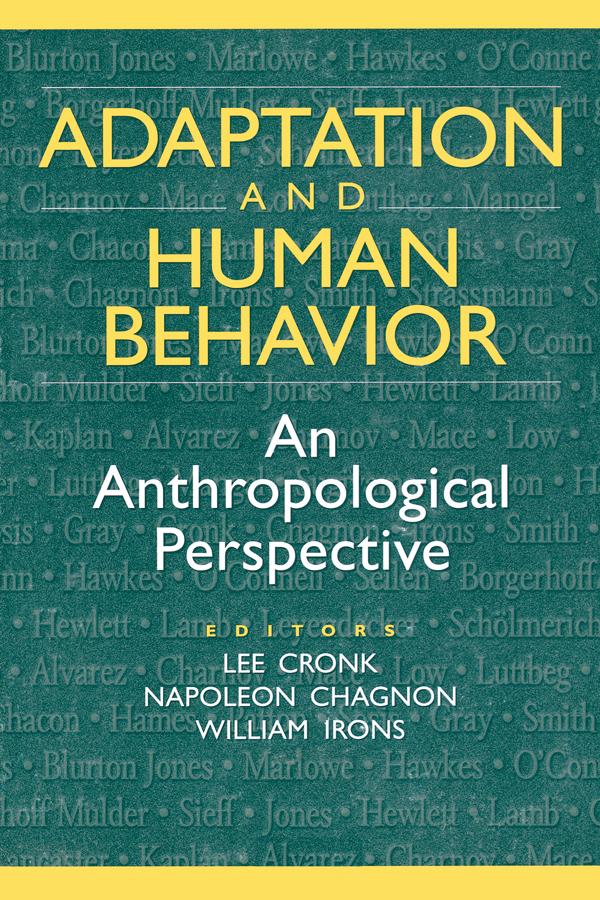
This volume presents state-of-the-art empirical studies working in a paradigm that has become known as human behavioral ecology. The emergence of this approach in anthropology was marked by publication by Aldine in 1979 of an earlier collection of studies edited by Chagnon and Irons entitled Evolutionary Biology and Human Social Behavior: An Anthropological Perspective. During the two decades that have passed since then, this innovative approach has matured and expanded into new areas that are explored here.
The book opens with an introductory chapter by Chagnon and Irons tracing the origins of human behavioral ecology and its subsequent development. Subsequent chapters, written by both younger scholars and established researchers, cover a wide range of societies and topics organ-ized into six sections. The first section includes two chapters that provide historical background on the development of human behavioral ecology and com-pare it to two complementary approaches in the study of evolution and human behavior, evolutionary psychology, and dual inheritance theory. The second section includes five studies of mating efforts in a variety of societies from South America and Africa. The third section covers parenting, with five studies on soci-eties from Africa, Asia, and North America. The fourth section breaks somewhat with the tradition in human behavioral ecology by focusing on one particularly problematic issue, the demographic transition, using data from Europe, North America, and Asia. The fifth section includes studies of cooperation and helping behaviors, using data from societies in Micronesia and South America. The sixth and final section consists of a single chapter that places the volume in a broader critical and comparative context.
The contributions to this volume demonstrate, with a high degree of theoretical and methodological sophistication--the maturity and freshness of this new paradigm in the study of human behavior. The volume will be of interest to anthropologists and other professions working on the study of cross-cultural human behavior.
Before Memmo my notes were scattered across PDFs. Now a workspace pulls everything into one place — I see exactly what's still left to study.
Memmo's summaries are gold before exams. I don't have to re-read 800 pages two weeks before — just the important parts.
The AI chat has saved me the night before an exam more than once. I just keep asking until I get it — no waiting on a study group to reply.
The quizzes hit exactly what I need to know. Memmo tracks what I get stuck on — so I only practice what's worth it.
Flashcards with spaced repetition are magic. Memmo knows when I'm about to forget something and brings it back.
The AI podcasts are my favorite. I listen on my way to school and get a recap without sitting at a computer.

Handbok i kvalitativa metoder
281 kr

Hållbar utveckling: en introduktion för ingenjörer och andra problemlösare
334 kr

Brymans Samhällsvetenskapliga metoder
390 kr

Projektledning
491 kr

Den orättvisa hälsan: om socioekonomiska skillnader i hälsa och livslängd
326 kr

Organizational Leadership
429 kr

Vetenskapsteori för nybörjare
196 kr

På väg mot läraryrket
172 kr

Det sociala livet i skolan: Socialpsykologiska perspektiv
253 kr

Betygsättningens didaktik
151 kr

Personality
402 kr

Studying Leadership
404 kr

Managing Innovation
477 kr

Introduktion till samhällsvetenskaplig metod
347 kr

The Psychology of Sex and Gender
698 kr

Evidens och kunskap för socialt arbete
207 kr

Introduction to Leadership
605 kr