
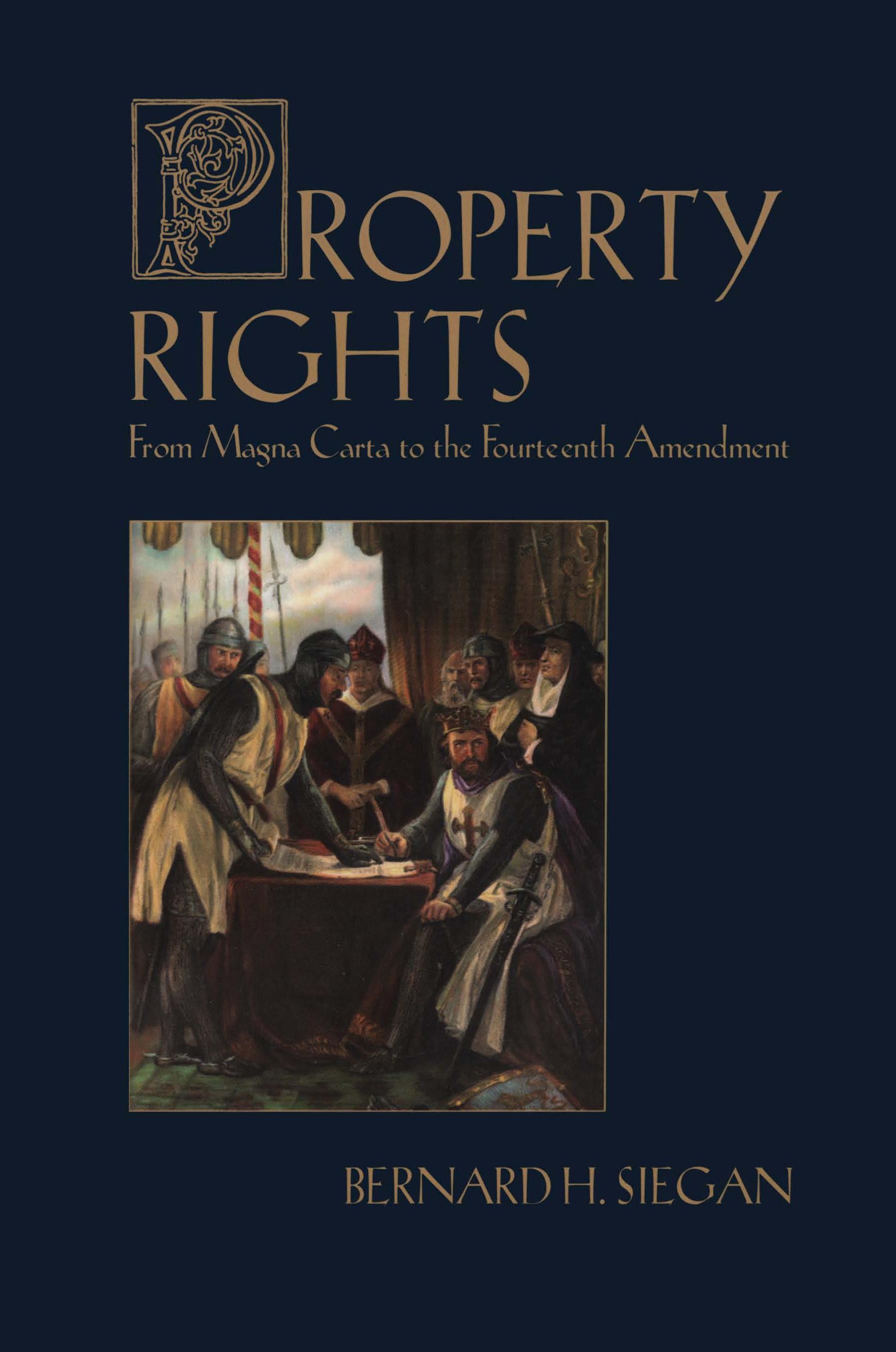
Property Rights: From Magna Carta to the Fourteenth Amendment breaks new ground in our understanding of the genesis of property rights in the United States. According to the standard interpretation, echoed by as lofty an authority as Supreme Court Justice Harry Blackmun, the courts did little in the way of protecting property rights in the early years of our nation. Not only does Siegan find this accepted teaching erroneous, but he finds post-Colonial jurisprudence to be firmly rooted in English common law and the writings of its most revered interpreters. Siegan conducts an exhaustive examination of property rights cases decided by state courts between the time of the ratification of the U.S. Constitution in 1788 and the adoption of the Fourteenth Amendment in 1868. This inventory, which in its sweep captures scores of cases overlooked by previous commentators on the history of property rights, reveals that the protection of these rights is neither a relatively new phenomenon nor a heritage with precarious pedigree. These court cases, as well as early state constitutions, consistently and repeatedly embraced key elements of a property rights jurisprudence, such as protection of the privileges and immunities of citizens, due process of law, equal protection under the law, and prohibitions on the taking of property without just compensation. Case law provides overwhelming evidence that the American legal system, from its inception, has held property rights and their protection in the highest regard.The American Revolution, Siegan reminds us, was fought largely to affirm and protect private property rights-that is, to uphold the "rights of Englishmen"-even if it meant that the colonists would cease being Englishmen. John Locke and other great theoreticians of property rights understood their importance, not only to individuals who happened to possess property, but to the preservation of a free society and to the prosperity of its inhabitants. Siegan's contribution to this venerable tradition lies in his faithful reconstruction of our legal history, which allows us to see just how central property rights have been to the American experiment in liberty-from the very beginning.
Pay easily by card, Klarna, Apple Pay or Google Pay. Not happy? You always have a 14-day money-back guarantee. Read more in our terms. If you have any questions, email us at hello@memmo.org.
Memmo makes studying easier – wherever you are in the world. We bring your course books and smart study tools together in one place: summaries, quizzes, podcasts and flashcards. Plus Ted, your study buddy who answers anything you wonder. Over 50,000 students already study here – built to help you learn faster and stress less.