
Before Memmo my notes were scattered across PDFs. Now a workspace pulls everything into one place — I see exactly what's still left to study.
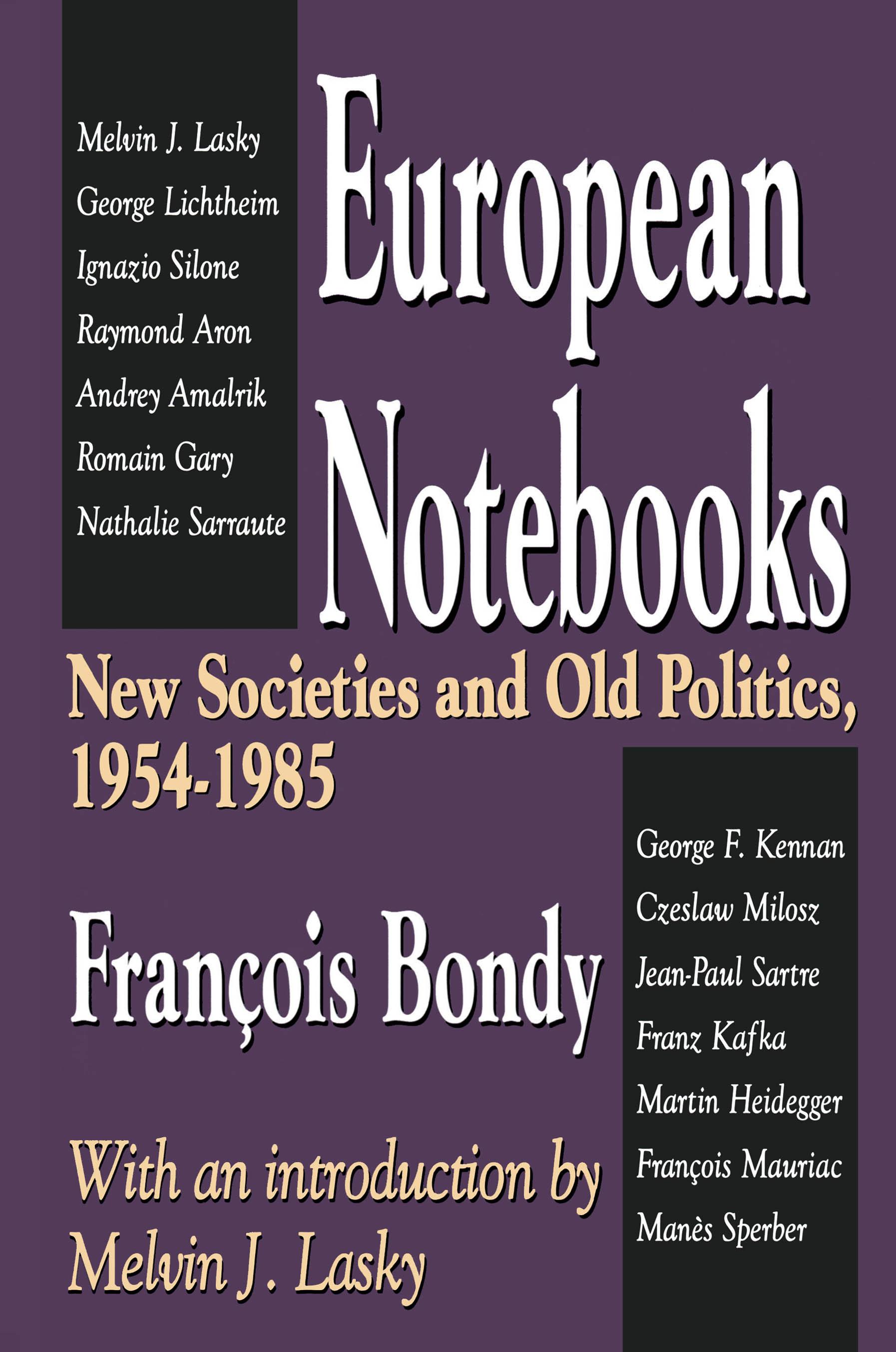
A generation of outstanding European thinkers emerged out of the rubble of World War II. It was a group unparalleled in their probing of an age that had produced totalitarianism as a political norm, and the Holocaust as its supreme nightmarish achievement. Figures ranging from George Lichtheim, Ignazio Silone, Raymond Aron, Andrei Amalrik, among many others, found a home in Encounter. None stood taller or saw further than François Bondy of Zurich.In a moving tribute to his friend, Melvin J. Lasky, long- time editor of Encounter, writes, "Bondy was a breathtaking spectacle. I had known him to read and walk, to think and talk, all at once--and still make mental notes for his next article.... Early or late, seated or standing, awake or asleep, his incomparable spiritedness would always be darting from point to point, paying attention and idly wandering at once. Taken all in all, he still continues to represent for me perhaps a Henry Jamesian New Man."Bondy's essays themselves represent a broad sweep of major figures and events in the second half of the twentieth century. His spatial outreach went from Budapest to Tokyo and Paris. His political essays extended from George Kennan to Benito Mussolini. And his prime mÚtier, the cultural figures of Europe, covered Sartre, Kafka, Heidegger and Milosz. The analysis was uniformly fair minded but unstinting in its insights. Taken together, the variegated themes he raised in his work as a Zurich journalist, a Paris editor, and a European homme de letres sketch guidelines for an entrancing portrait of the intellectual as cosmopolitan.European Notebooks contains most of the articles that Bondy (1915-2003) wrote for Encounter under the stewardship of Stephen Spender, Irving Kristol, and then for the thirty years that Melvin Lasky served as editor. Bondy was that rare unattached intellectual, "free of every totalitarian temptation" and, as Lasky notes, unfailing in his devotion to the liberties and civilities of a humane social order. European Notebooks offers a window into a civilization that came to maturity during the period in which these essays were written.
Before Memmo my notes were scattered across PDFs. Now a workspace pulls everything into one place — I see exactly what's still left to study.
Memmo's summaries are gold before exams. I don't have to re-read 800 pages two weeks before — just the important parts.
The AI chat has saved me the night before an exam more than once. I just keep asking until I get it — no waiting on a study group to reply.
The quizzes hit exactly what I need to know. Memmo tracks what I get stuck on — so I only practice what's worth it.
Flashcards with spaced repetition are magic. Memmo knows when I'm about to forget something and brings it back.
The AI podcasts are my favorite. I listen on my way to school and get a recap without sitting at a computer.

Handbok i kvalitativa metoder
281 kr

Hållbar utveckling: en introduktion för ingenjörer och andra problemlösare
334 kr

Brymans Samhällsvetenskapliga metoder
390 kr

Projektledning
491 kr

Den orättvisa hälsan: om socioekonomiska skillnader i hälsa och livslängd
326 kr

Vetenskapsteori för nybörjare
196 kr

Organizational Leadership
429 kr

På väg mot läraryrket
172 kr

Det sociala livet i skolan: Socialpsykologiska perspektiv
253 kr

Betygsättningens didaktik
151 kr

Personality
402 kr

Studying Leadership
404 kr

Managing Innovation
477 kr

Introduktion till samhällsvetenskaplig metod
347 kr

The Psychology of Sex and Gender
698 kr

Evidens och kunskap för socialt arbete
207 kr

Introduction to Leadership
605 kr