
Before Memmo my notes were scattered across PDFs. Now a workspace pulls everything into one place — I see exactly what's still left to study.
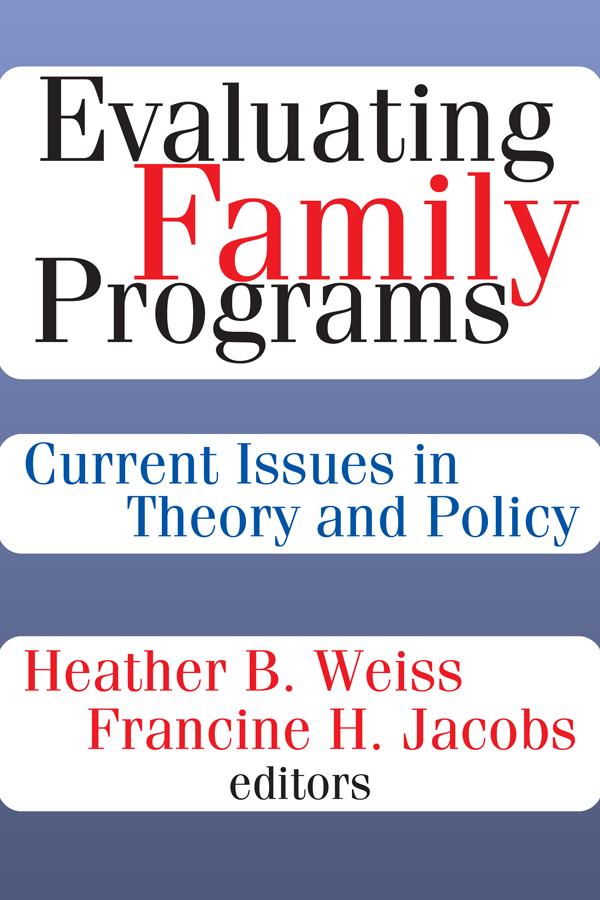
The diverse composition of American families and changing ways of raising our children have become subjects of intense scrutiny by researchers and policymakers in recent years. Shifting demographics and work patterns, growing numbers of women in the work force, teenage pregnancy, single-parent families, and the deinstitutionalization of the elderly, disabled, and mentally ill--all these trends have significantly affected family life. Evaluating Family Programs effectively bridges the gap between researchers and practitioners in order to bring practical, understandable advice to providers of family programs and to program funders and policymakers.
Heather B. Weiss and Francine H. Jacobs have collected in this volume works which move outside the traditional approaches of their disciplines to create new models for delivering and evaluating services. This sets a mood of genuine inquiry and excitement about successful aspects of programs while maintaining openness about the limitations of both research and practice. By expanding the research model, this work is an attempt to understand reciprocal influences of extended family, culture, community, and social institutions. It urges those who advocate program accountability to understand that not all types of evaluations are appropriate for all programs, and it notes that limitations in current evaluation technologies make it difficult to evaluate outcomes.
Evaluating Family Programs reminds the reader that in order to develop sound family policy we must look at children and families in context. Beacuse policymakers, program administrators, and informed citizens have come to rely more upon the results of evaluation research, we must improve our methods while not losing sight of its limitations. It is a thought-provoking contribution to the efforts of those who seek to support the American family with compassion, understanding, and realism.
Before Memmo my notes were scattered across PDFs. Now a workspace pulls everything into one place — I see exactly what's still left to study.
Memmo's summaries are gold before exams. I don't have to re-read 800 pages two weeks before — just the important parts.
The AI chat has saved me the night before an exam more than once. I just keep asking until I get it — no waiting on a study group to reply.
The quizzes hit exactly what I need to know. Memmo tracks what I get stuck on — so I only practice what's worth it.
Flashcards with spaced repetition are magic. Memmo knows when I'm about to forget something and brings it back.
The AI podcasts are my favorite. I listen on my way to school and get a recap without sitting at a computer.

Handbok i kvalitativa metoder
281 kr

Hållbar utveckling: en introduktion för ingenjörer och andra problemlösare
334 kr

Brymans Samhällsvetenskapliga metoder
390 kr

Projektledning
491 kr

Den orättvisa hälsan: om socioekonomiska skillnader i hälsa och livslängd
326 kr

Organizational Leadership
429 kr

Vetenskapsteori för nybörjare
196 kr

På väg mot läraryrket
172 kr

Det sociala livet i skolan: Socialpsykologiska perspektiv
253 kr

Betygsättningens didaktik
151 kr

Personality
402 kr

Studying Leadership
404 kr

Managing Innovation
477 kr

Introduktion till samhällsvetenskaplig metod
347 kr

The Psychology of Sex and Gender
698 kr

Evidens och kunskap för socialt arbete
207 kr

Introduction to Leadership
605 kr