
Before Memmo my notes were scattered across PDFs. Now a workspace pulls everything into one place — I see exactly what's still left to study.
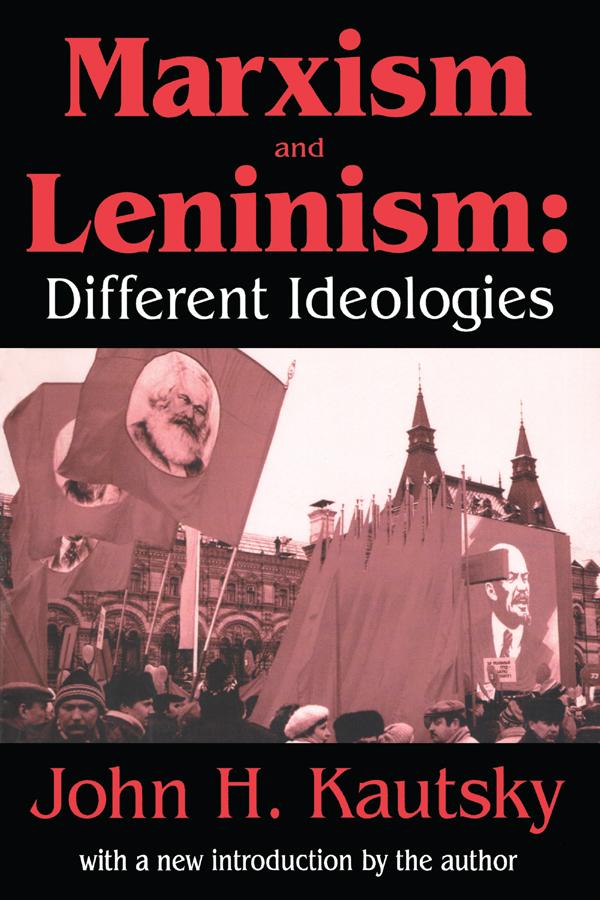
One of the pre-eminent scholars in the history and theory of European socialism, John Kautsky in this volume develops the argument that Marxism and Leninism are two quite different ideologies. He counterposes this view with the commonly accepted one of Leninism as simply one form that Marxism took in the course of its evolution. The easy identification of Marxism and Leninism with each other has been responsible for great confusion in the realm of both scholarly and political discourse.
Kautsky develops his position within the tradition of the sociology of knowledge, by the close examination of the different meanings of the Marxist vocabulary as it was used by Marxists and Leninists. His frame of reference turns on the position of labor in turn-of-the-century industrial Europe and the role of modernizing intellectuals in underdeveloped countries. While the vocabulary used was often common to Marx and Lenin, Marxism was explicitly concerned with appeals to workers in industrial nations such as Germany and Austria, whereas Leninism appeals to revolutionaries in underdeveloped nations such as Russia and China.
Whatever be the current assessment of the future of socialism and communism, Kautsky holds that it is important to study the core structure of both Marxism and Leninism, since they were major phenomena that powerfully affected the world in the twentieth century. Beyond that, in dealing with how different ideologies can be ensconced within the same rhetoric, the book offers an outstanding entrance into the sociology of knowledge as a tool for political analysis. This is a unique work in the function of language no less than the nature of ideology.
The work is divided into five parts: Two environments, two ideologies, one terminology. The evolution of Marxism, its appeals in the German Empire. The evolution of Leninism, its appeals to strata involved in making modernizing revolutions. The differential outcomes of Marxism in the East and Leninism in the West. And finally, an examination of why Marxism and Leninism have been seen as a single ideology. In a new essay prepared for this new edition, Kautsky provides important autobiographical as well as historical reflections on how this book fits into the overall pattern of the author's work.
Before Memmo my notes were scattered across PDFs. Now a workspace pulls everything into one place — I see exactly what's still left to study.
Memmo's summaries are gold before exams. I don't have to re-read 800 pages two weeks before — just the important parts.
The AI chat has saved me the night before an exam more than once. I just keep asking until I get it — no waiting on a study group to reply.
The quizzes hit exactly what I need to know. Memmo tracks what I get stuck on — so I only practice what's worth it.
Flashcards with spaced repetition are magic. Memmo knows when I'm about to forget something and brings it back.
The AI podcasts are my favorite. I listen on my way to school and get a recap without sitting at a computer.

Handbok i kvalitativa metoder
281 kr

Hållbar utveckling: en introduktion för ingenjörer och andra problemlösare
334 kr

Brymans Samhällsvetenskapliga metoder
390 kr

Projektledning
491 kr

Den orättvisa hälsan: om socioekonomiska skillnader i hälsa och livslängd
326 kr

Organizational Leadership
429 kr

Vetenskapsteori för nybörjare
196 kr

På väg mot läraryrket
172 kr

Det sociala livet i skolan: Socialpsykologiska perspektiv
253 kr

Betygsättningens didaktik
151 kr

Personality
402 kr

Studying Leadership
404 kr

Managing Innovation
477 kr

Introduktion till samhällsvetenskaplig metod
347 kr

The Psychology of Sex and Gender
698 kr

Evidens och kunskap för socialt arbete
207 kr

Introduction to Leadership
605 kr