
Before Memmo my notes were scattered across PDFs. Now a workspace pulls everything into one place — I see exactly what's still left to study.
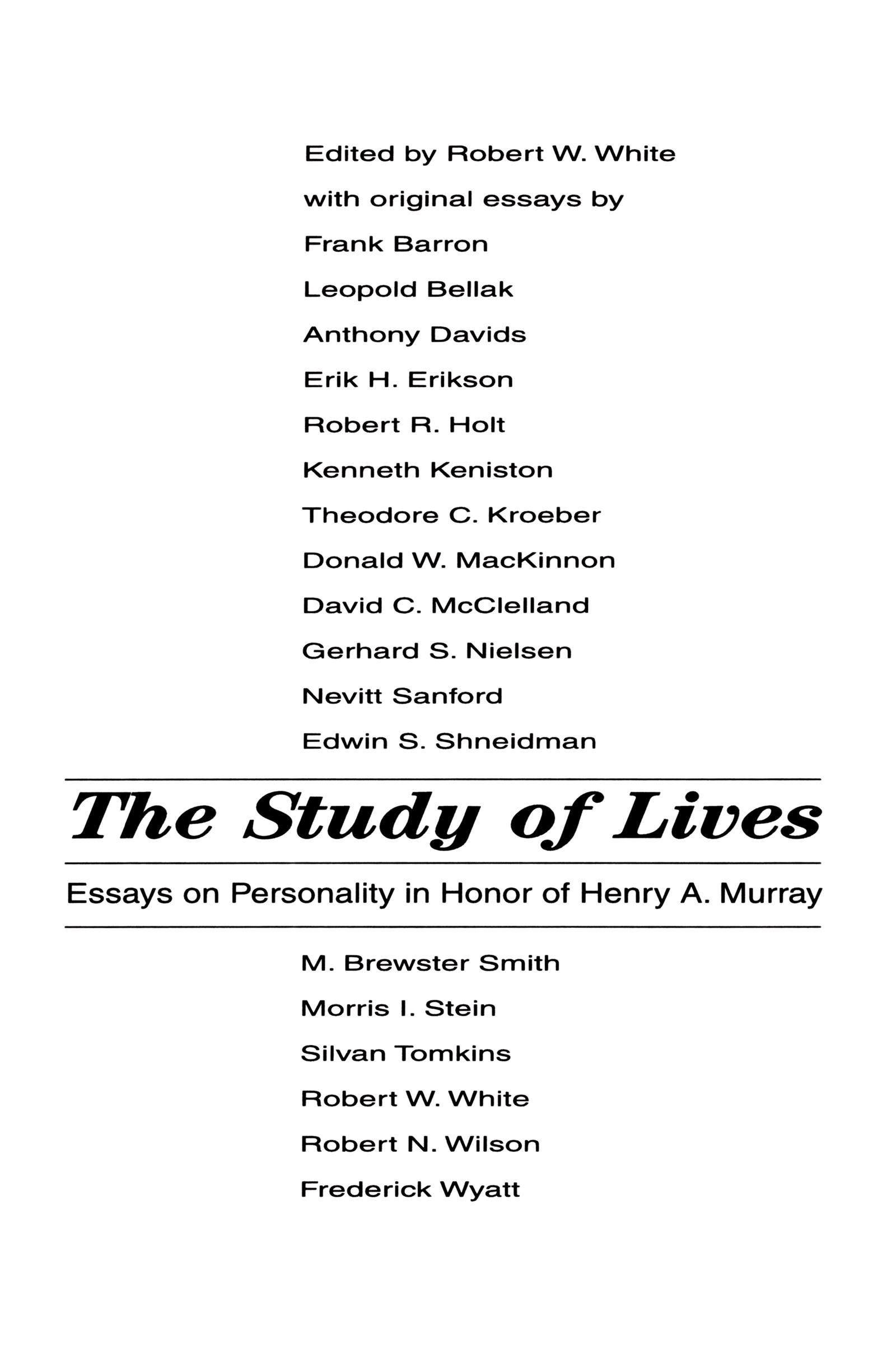
The Study of Lives reveals for the first time the extent of Henry A. Murray's considerable influence on the study of personality. Throughout his long and distinguished career, he has either trained or strongly influenced some of the world's leading psychologists, eighteen of whom have written fascinating essays for this book. The range of topics presented here is as diverse and highly original as Murray's own ideas about personality. Everyone concerned with the study of personality will find this book an excellent sampling of the best work being done in the field.
"The study of lives" is a phrase Henry A. Murray has often used to describe his own work, and it suggests his central conviction that living beings must be studied as living wholes. Personality, he has repeatedly pointed out, is a dynamic process-a constantly changing configuration of thoughts, feelings, and actions occurring in a social environment and continuing throughout life. If small parts and short segments of human affairs have to be isolated for detailed scrutiny, they must still be understood as parts of a patterned organic system and as segments of a lifelong process. This has never meant for him that all research should take the form of collecting life histories, although his contributions along this line have been outstanding. It implies simply that isolating, fragmenting, and learning just a tiny bit about a lot of people tend to carry us away from what is most worth studying.
The essays in this book are grouped under headings that represent some of Murray's strongest interests: His conception of personality as a dynamic process is reflected in Part I, which deals with continuities and changes in the course of life. His interest in devising procedures suitable for disclosing live feelings, fantasies, and adaptations and his insistence on the necessity for an adequate taxonomy of carefully discriminated, carefully defined variables are represented in the papers of Part II. His view that creativity is a central property of human nature has contributed to the reflections and researches that make up Part III. Finally, his concern with values--the great blind spot of traditional science but so obviously a momentous problem for contemporary lives and societies--has been taken up in several different ways by the authors of Part IV.
Before Memmo my notes were scattered across PDFs. Now a workspace pulls everything into one place — I see exactly what's still left to study.
Memmo's summaries are gold before exams. I don't have to re-read 800 pages two weeks before — just the important parts.
The AI chat has saved me the night before an exam more than once. I just keep asking until I get it — no waiting on a study group to reply.
The quizzes hit exactly what I need to know. Memmo tracks what I get stuck on — so I only practice what's worth it.
Flashcards with spaced repetition are magic. Memmo knows when I'm about to forget something and brings it back.
The AI podcasts are my favorite. I listen on my way to school and get a recap without sitting at a computer.

Handbok i kvalitativa metoder
281 kr

Hållbar utveckling: en introduktion för ingenjörer och andra problemlösare
334 kr

Brymans Samhällsvetenskapliga metoder
390 kr

Projektledning
491 kr

Den orättvisa hälsan: om socioekonomiska skillnader i hälsa och livslängd
326 kr

Organizational Leadership
429 kr

Vetenskapsteori för nybörjare
196 kr

På väg mot läraryrket
172 kr

Det sociala livet i skolan: Socialpsykologiska perspektiv
253 kr

Betygsättningens didaktik
151 kr

Personality
402 kr

Studying Leadership
404 kr

Managing Innovation
477 kr

Introduktion till samhällsvetenskaplig metod
347 kr

The Psychology of Sex and Gender
698 kr

Evidens och kunskap för socialt arbete
207 kr

Introduction to Leadership
605 kr