
Before Memmo my notes were scattered across PDFs. Now a workspace pulls everything into one place — I see exactly what's still left to study.
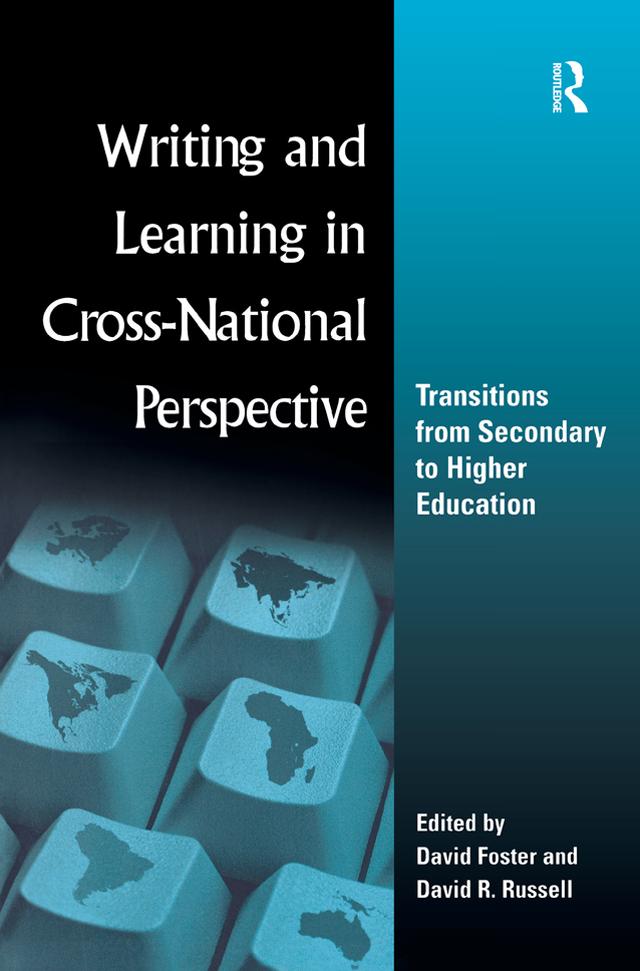
Despite the increasingly global implications of conversations about writing and learning, U.S. composition studies has devoted little attention to cross-national perspectives on student writing and its roles in wider cultural contexts. Caught up in our own concerns about how U.S. students make the transition as writers from secondary school to postsecondary education, we often overlook the fact that students around the world are undergoing the same evolution. How do the students in China, England, France, Germany, Kenya, or South Africa--the educational systems represented in this collection--write their way into the communities of their chosen disciplines? How, for instance, do students whose mother tongue is not the language of instruction cope with the demands of academic and discipline-specific writing? And in what ways is U.S. students' development as academic writers similar to or different from that of students in other countries?
With this collection, editors David Foster and David R. Russell broaden the discussion about the role of writing in various educational systems and cultures. Students' development as academic writers raises issues of student authorship and agency, as well as larger issues of educational access, institutional power relations, system goals, and students' roles in society. The contributors to this collection discuss selected writing purposes and forms characteristic of a specific national education system, describe students' agency as writers, and identify contextual factors--social, economic, linguistic, cultural--that shape institutional responses to writing development.
In discussions that bookend these studies of different educational structures, the editors compare U.S. postsecondary writing practices and pedagogies with those in other national systems, and suggest new perspectives for cross-national study of learning/writing issues important to all educational systems. Given the worldwide increase in students entering higher education and the endless need for effective writing across disciplines and nations, the insights offered here and the call for further studies are especially welcome and timely.
Before Memmo my notes were scattered across PDFs. Now a workspace pulls everything into one place — I see exactly what's still left to study.
Memmo's summaries are gold before exams. I don't have to re-read 800 pages two weeks before — just the important parts.
The AI chat has saved me the night before an exam more than once. I just keep asking until I get it — no waiting on a study group to reply.
The quizzes hit exactly what I need to know. Memmo tracks what I get stuck on — so I only practice what's worth it.
Flashcards with spaced repetition are magic. Memmo knows when I'm about to forget something and brings it back.
The AI podcasts are my favorite. I listen on my way to school and get a recap without sitting at a computer.

Handbok i kvalitativa metoder
281 kr

Hållbar utveckling: en introduktion för ingenjörer och andra problemlösare
334 kr

Brymans Samhällsvetenskapliga metoder
390 kr

Projektledning
491 kr

Den orättvisa hälsan: om socioekonomiska skillnader i hälsa och livslängd
326 kr

Vetenskapsteori för nybörjare
196 kr

Organizational Leadership
429 kr

På väg mot läraryrket
172 kr

Det sociala livet i skolan: Socialpsykologiska perspektiv
253 kr

Betygsättningens didaktik
151 kr

Personality
402 kr

Studying Leadership
404 kr

Managing Innovation
477 kr

Introduktion till samhällsvetenskaplig metod
347 kr

The Psychology of Sex and Gender
698 kr

Evidens och kunskap för socialt arbete
207 kr

Introduction to Leadership
605 kr