
Before Memmo my notes were scattered across PDFs. Now a workspace pulls everything into one place — I see exactly what's still left to study.
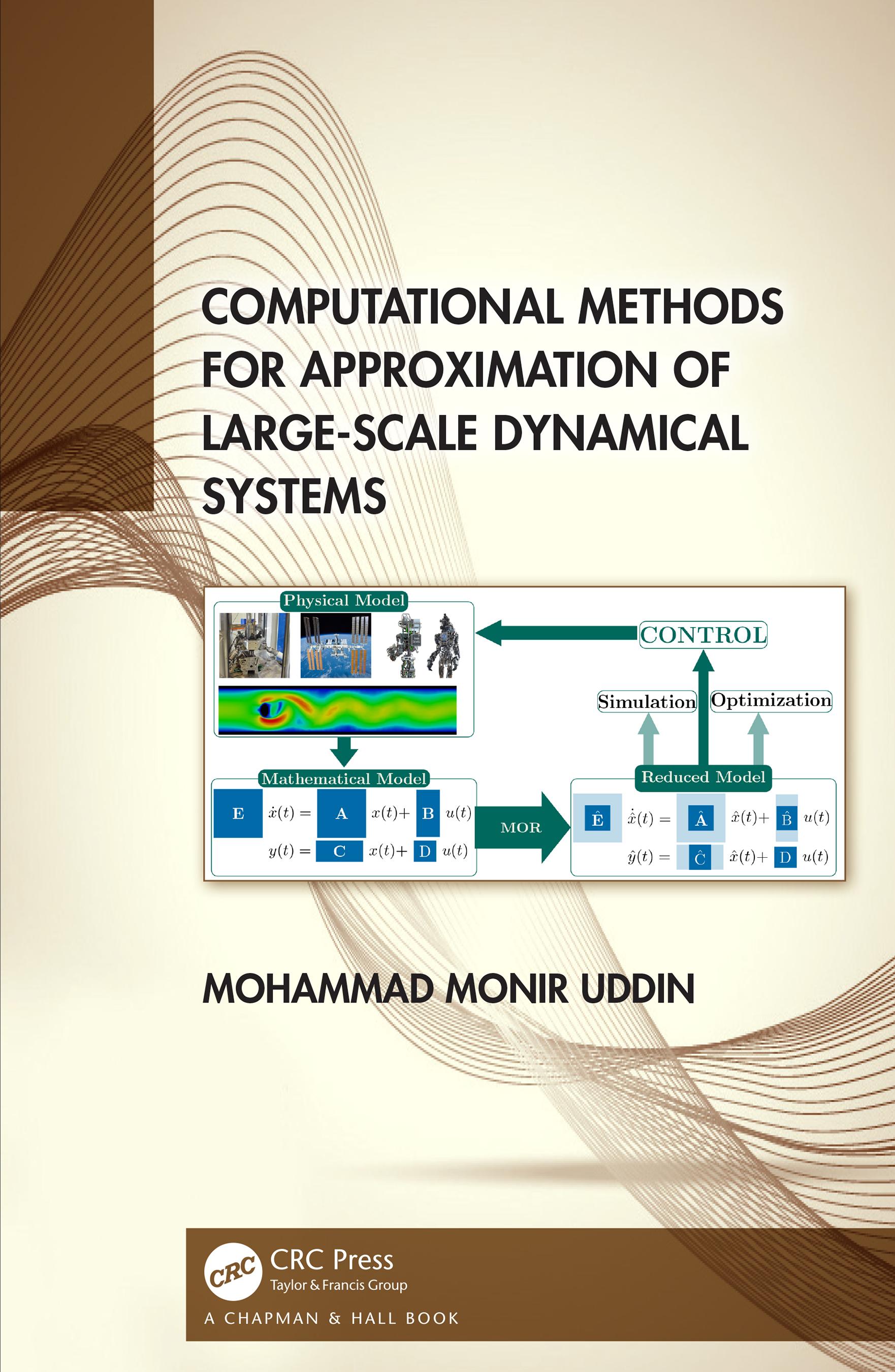
These days, computer-based simulation is considered the quintessential approach to exploring new ideas in the different disciplines of science, engineering and technology (SET). To perform simulations, a physical system needs to be modeled using mathematics; these models are often represented by linear time-invariant (LTI) continuous-time (CT) systems. Oftentimes these systems are subject to additional algebraic constraints, leading to first- or second-order differential-algebraic equations (DAEs), otherwise known as descriptor systems. Such large-scale systems generally lead to massive memory requirements and enormous computational complexity, thus restricting frequent simulations, which are required by many applications. To resolve these complexities, the higher-dimensional system may be approximated by a substantially lower-dimensional one through model order reduction (MOR) techniques. Computational Methods for Approximation of Large-Scale Dynamical Systems discusses computational techniques for the MOR of large-scale sparse LTI CT systems. Although the book puts emphasis on the MOR of descriptor systems, it begins by showing and comparing the various MOR techniques for standard systems.
The book also discusses the low-rank alternating direction implicit (LR-ADI) iteration and the issues related to solving the Lyapunov equation of large-scale sparse LTI systems to compute the low-rank Gramian factors, which are important components for implementing the Gramian-based MOR.
Although this book is primarly aimed at post-graduate students and researchers of the various SET disciplines, the basic contents of this book can be supplemental to the advanced bachelor's-level students as well. It can also serve as an invaluable reference to researchers working in academics and industries alike.
Features:
Before Memmo my notes were scattered across PDFs. Now a workspace pulls everything into one place — I see exactly what's still left to study.
Memmo's summaries are gold before exams. I don't have to re-read 800 pages two weeks before — just the important parts.
The AI chat has saved me the night before an exam more than once. I just keep asking until I get it — no waiting on a study group to reply.
The quizzes hit exactly what I need to know. Memmo tracks what I get stuck on — so I only practice what's worth it.
Flashcards with spaced repetition are magic. Memmo knows when I'm about to forget something and brings it back.
The AI podcasts are my favorite. I listen on my way to school and get a recap without sitting at a computer.

Handbok i kvalitativa metoder
281 kr

Hållbar utveckling: en introduktion för ingenjörer och andra problemlösare
334 kr

Brymans Samhällsvetenskapliga metoder
390 kr

Projektledning
491 kr

Den orättvisa hälsan: om socioekonomiska skillnader i hälsa och livslängd
326 kr

Organizational Leadership
429 kr

Vetenskapsteori för nybörjare
196 kr

På väg mot läraryrket
172 kr

Det sociala livet i skolan: Socialpsykologiska perspektiv
253 kr

Betygsättningens didaktik
151 kr

Personality
402 kr

Studying Leadership
404 kr

Managing Innovation
477 kr

Introduktion till samhällsvetenskaplig metod
347 kr

The Psychology of Sex and Gender
698 kr

Evidens och kunskap för socialt arbete
207 kr

Introduction to Leadership
605 kr