
Before Memmo my notes were scattered across PDFs. Now a workspace pulls everything into one place — I see exactly what's still left to study.
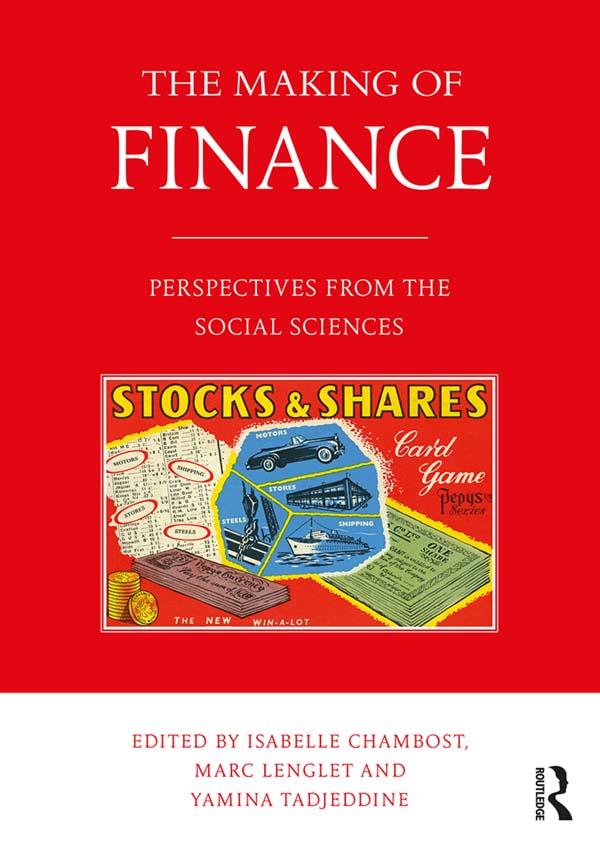
Using a variety of theoretical frameworks drawn from the social sciences, the contributions in this edited collection offer a critical perspective on the dominant paradigms used in contemporary financial activities. Through a detailed study of the organisation and functioning of financial intermediaries and institutions, the contributors to this volume analyse ‘finance in the making’, by shedding light on the structuring of banking and financial systems, on their capacity to prescribe action and control, on their modes of regulation and, more generally, on the process of financialisation.
Contributions presented in this volume have been written by authors working within the ‘social studies of finance’ tradition, a research programme that emerged twenty years ago, with the aim of addressing a diversity of financial fieldworks and related theoretical questions. This book, therefore, sheds light on different areas that are representative of contemporary financial realities. Specifically, it first studies the work of financial employees: traders, salespeople, investment managers, financial analysts, investment consultants, etc. but also provides an analysis of a range of financial instruments: financial schemes and contracts, financial derivatives, socially responsible investment funds, as well as market rules and regulations. Finally, it puts into perspective the organisations contributing to this financial reality: those developing and selling financial services (retail banks, brokerage houses, asset management firms, private equity firms, etc.), and also those contributing to the regulation of such activities (banking regulators, financial market authorities, credit rating agencies, the State, to name a few).
Each text can be read without any specific knowledge of finance; the book is thus addressed to anyone willing to better understand the intricacies of contemporary financial realities.
Before Memmo my notes were scattered across PDFs. Now a workspace pulls everything into one place — I see exactly what's still left to study.
Memmo's summaries are gold before exams. I don't have to re-read 800 pages two weeks before — just the important parts.
The AI chat has saved me the night before an exam more than once. I just keep asking until I get it — no waiting on a study group to reply.
The quizzes hit exactly what I need to know. Memmo tracks what I get stuck on — so I only practice what's worth it.
Flashcards with spaced repetition are magic. Memmo knows when I'm about to forget something and brings it back.
The AI podcasts are my favorite. I listen on my way to school and get a recap without sitting at a computer.

Handbok i kvalitativa metoder
281 kr

Hållbar utveckling: en introduktion för ingenjörer och andra problemlösare
334 kr

Brymans Samhällsvetenskapliga metoder
390 kr

Projektledning
491 kr

Den orättvisa hälsan: om socioekonomiska skillnader i hälsa och livslängd
326 kr

Vetenskapsteori för nybörjare
196 kr

Organizational Leadership
429 kr

På väg mot läraryrket
172 kr

Det sociala livet i skolan: Socialpsykologiska perspektiv
253 kr

Betygsättningens didaktik
151 kr

Personality
402 kr

Studying Leadership
404 kr

Managing Innovation
477 kr

Introduktion till samhällsvetenskaplig metod
347 kr

The Psychology of Sex and Gender
698 kr

Evidens och kunskap för socialt arbete
207 kr

Introduction to Leadership
605 kr