
Before Memmo my notes were scattered across PDFs. Now a workspace pulls everything into one place — I see exactly what's still left to study.
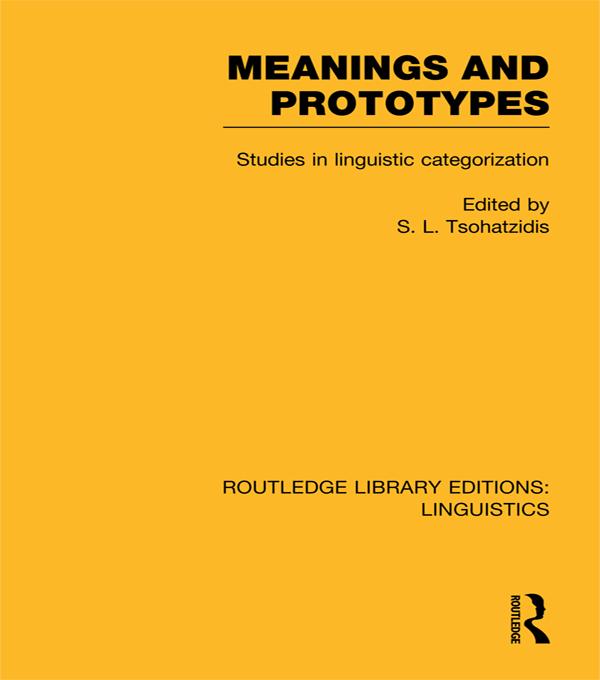
There are fewer distinctions in any language than there are distinct things in the universe. If, therefore, languages are ways of representing the universe, a primary function of their elements must be to allow the much more varied kinds of elements out of which the universe is made to be categorized in specific ways. A prototype approach to linguistic categories is a particular way of answering the question of how this categorization operates. It involves two claims. First, that linguistic categorization exploits principles that are not specific to language but characterize most, if not all, processes of cognition. Secondly, that a basic principle by which cognitive and linguistic categories are organized is the prototype principle, which assigns elements to a category not because they exemplify properties that are absolutely required of each one of its members, but because they exhibit, in varying degrees, certain types of similarity with a particular category member which has been established as the best example (or: prototype) of its kind.
The development of the prototype approach into a satisfactory body of theory obviously requires both that its empirical base be enriched, and that its conceptual foundations be clarified. These are the areas where this volume, in its 26 essays, makes original contributions. The first two parts contain discussions in which various kinds of linguistic phenomena are analysed in ways that make essential use of prototype notions. The last two parts contain discussions in which prototype notions themselves become the object, rather than the instrument, of analytical scrutiny.
Before Memmo my notes were scattered across PDFs. Now a workspace pulls everything into one place — I see exactly what's still left to study.
Memmo's summaries are gold before exams. I don't have to re-read 800 pages two weeks before — just the important parts.
The AI chat has saved me the night before an exam more than once. I just keep asking until I get it — no waiting on a study group to reply.
The quizzes hit exactly what I need to know. Memmo tracks what I get stuck on — so I only practice what's worth it.
Flashcards with spaced repetition are magic. Memmo knows when I'm about to forget something and brings it back.
The AI podcasts are my favorite. I listen on my way to school and get a recap without sitting at a computer.

Handbok i kvalitativa metoder
281 kr

Hållbar utveckling: en introduktion för ingenjörer och andra problemlösare
334 kr

Brymans Samhällsvetenskapliga metoder
390 kr

Projektledning
491 kr

Den orättvisa hälsan: om socioekonomiska skillnader i hälsa och livslängd
326 kr

Vetenskapsteori för nybörjare
196 kr

Organizational Leadership
429 kr

På väg mot läraryrket
172 kr

Det sociala livet i skolan: Socialpsykologiska perspektiv
253 kr

Betygsättningens didaktik
151 kr

Personality
402 kr

Studying Leadership
404 kr

Managing Innovation
477 kr

Introduktion till samhällsvetenskaplig metod
347 kr

The Psychology of Sex and Gender
698 kr

Evidens och kunskap för socialt arbete
207 kr

Introduction to Leadership
605 kr