
Before Memmo my notes were scattered across PDFs. Now a workspace pulls everything into one place — I see exactly what's still left to study.
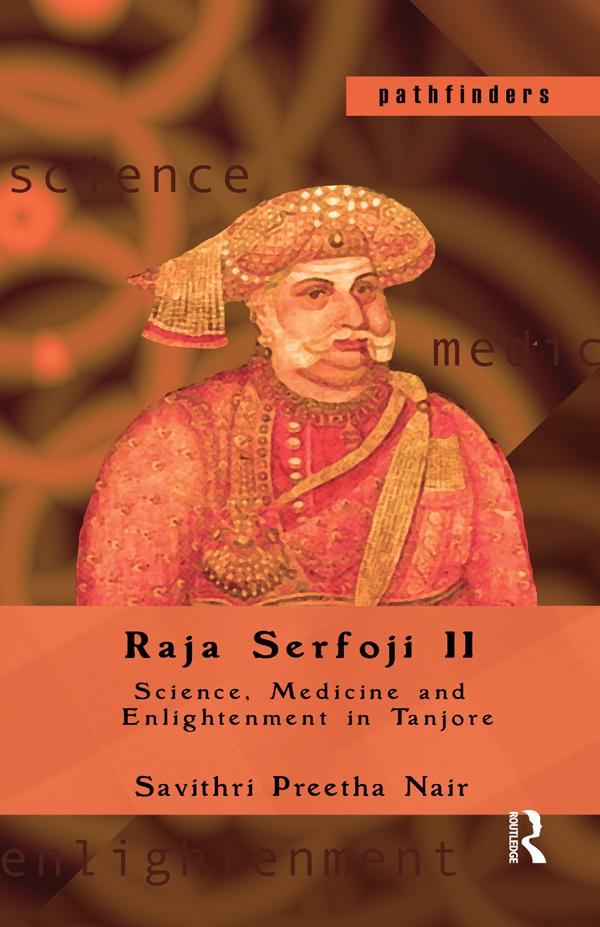
In the early nineteenth century, the south Indian kingdom of Tanjore, which had come under the control of the East India Company, flourished as a ‘centre’ of enlightenment. This book traces the contours of the Tanjore enlightenment, which produced a knowledge that was at once modern and deeply rooted in the indigenous tradition. The chief protagonist of this first ever full-length study on Tanjore at the turn of the nineteenth century is Raja Serfoji II (r. 1798–1832), in whose world science and God coexisted comfortably.
Tanjore at this time was a thriving contact-zone, linked to several centres through extensive local and global networks. Its court attracted a great number of visitors, including Christian missionaries, high-ranking Company officials, princely contemporaries, naturalists, and medical practitioners. Dwelling on the locatedness of science and enlightenment modernity in the context of the colonial periphery, the book describes how the Raja deployed certain ‘vectors of assemblage’ — an array of practices, instruments, theories and people, including his vast collection of manuscripts, books and scientific instruments, a Devanagari printing press, a menagerie, health establishments and a large retinue of trained experts and artists — to invent Tanjore as a contemporary ‘centre’.
Shunning reductionist and diffusionist explanations of the transmission of Western science in colonial settings, the study uses hitherto unexplored archival sources to reconstruct the Tanjore enlightenment as the outcome of globally situated cross-cultural exchanges. It celebrates the openness and confidence with which European science was engaged with, assimilated, translated and reinvented in a ‘contact-zone’ located in the colonial backwaters of south India.
The book will be of interest to historians, sociologists and those interested in history of science and medicine, anthropologists, cultural studies scholars, as well as the general reader.
Before Memmo my notes were scattered across PDFs. Now a workspace pulls everything into one place — I see exactly what's still left to study.
Memmo's summaries are gold before exams. I don't have to re-read 800 pages two weeks before — just the important parts.
The AI chat has saved me the night before an exam more than once. I just keep asking until I get it — no waiting on a study group to reply.
The quizzes hit exactly what I need to know. Memmo tracks what I get stuck on — so I only practice what's worth it.
Flashcards with spaced repetition are magic. Memmo knows when I'm about to forget something and brings it back.
The AI podcasts are my favorite. I listen on my way to school and get a recap without sitting at a computer.

Handbok i kvalitativa metoder
281 kr

Hållbar utveckling: en introduktion för ingenjörer och andra problemlösare
334 kr

Brymans Samhällsvetenskapliga metoder
390 kr

Projektledning
491 kr

Den orättvisa hälsan: om socioekonomiska skillnader i hälsa och livslängd
326 kr

Organizational Leadership
429 kr

Vetenskapsteori för nybörjare
196 kr

På väg mot läraryrket
172 kr

Det sociala livet i skolan: Socialpsykologiska perspektiv
253 kr

Betygsättningens didaktik
151 kr

Personality
402 kr

Studying Leadership
404 kr

Managing Innovation
477 kr

Introduktion till samhällsvetenskaplig metod
347 kr

The Psychology of Sex and Gender
698 kr

Evidens och kunskap för socialt arbete
207 kr

Introduction to Leadership
605 kr