
Before Memmo my notes were scattered across PDFs. Now a workspace pulls everything into one place — I see exactly what's still left to study.
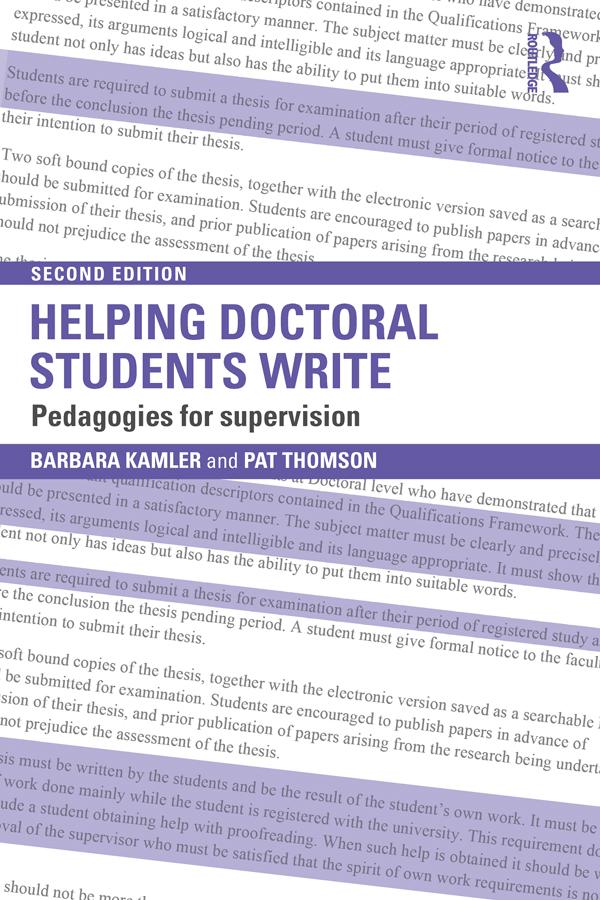
Helping Doctoral Students Write offers a proven approach to effective doctoral writing. By treating research as writing and writing as research, the authors offer pedagogical strategies for doctoral supervisors that will assist the production of well-argued and lively dissertations.
It is clear that many doctoral candidates find research writing complicated and difficult, but the advice they receive often glosses over the complexities of writing and/or locates the problem in the writer. Kamler and Thomson provide a highly effective framework for scholarly work that is located in personal, institutional and cultural contexts.
The pedagogical approach developed in the book is based on the notion of writing as a social practice. This approach allows supervisors to think of doctoral writers as novices who need to learn new ways with words as they enter the discursive practices of scholarly communities. This involves learning sophisticated writing practices with specific sets of conventions and textual characteristics. The authors offer supervisors practical advice on helping with commonly encountered writing tasks such as the proposal, the journal abstract, the literature review and constructing the dissertation argument.
The first edition of this book has helped many academics and thousands of research students produce better written material. Now fully updated the second edition includes:
Their discussion of the complexities of forming a scholarly identity is illustrated throughout by stories and writings of actual doctoral students.
In conclusion, they present a persuasive and proven argument that universities must move away from simply auditing supervision to supporting the development of scholarly research communities. Any supervisor keen to help their students develop as academics will find the ideas and practical solutions presented in this book fascinating and insightful reading.
Before Memmo my notes were scattered across PDFs. Now a workspace pulls everything into one place — I see exactly what's still left to study.
Memmo's summaries are gold before exams. I don't have to re-read 800 pages two weeks before — just the important parts.
The AI chat has saved me the night before an exam more than once. I just keep asking until I get it — no waiting on a study group to reply.
The quizzes hit exactly what I need to know. Memmo tracks what I get stuck on — so I only practice what's worth it.
Flashcards with spaced repetition are magic. Memmo knows when I'm about to forget something and brings it back.
The AI podcasts are my favorite. I listen on my way to school and get a recap without sitting at a computer.

Handbok i kvalitativa metoder
281 kr

Hållbar utveckling: en introduktion för ingenjörer och andra problemlösare
334 kr

Brymans Samhällsvetenskapliga metoder
390 kr

Projektledning
491 kr

Den orättvisa hälsan: om socioekonomiska skillnader i hälsa och livslängd
326 kr

Vetenskapsteori för nybörjare
196 kr

Organizational Leadership
429 kr

På väg mot läraryrket
172 kr

Det sociala livet i skolan: Socialpsykologiska perspektiv
253 kr

Betygsättningens didaktik
151 kr

Personality
402 kr

Studying Leadership
404 kr

Managing Innovation
477 kr

Introduktion till samhällsvetenskaplig metod
347 kr

The Psychology of Sex and Gender
698 kr

Evidens och kunskap för socialt arbete
207 kr

Introduction to Leadership
605 kr