
Before Memmo my notes were scattered across PDFs. Now a workspace pulls everything into one place — I see exactly what's still left to study.
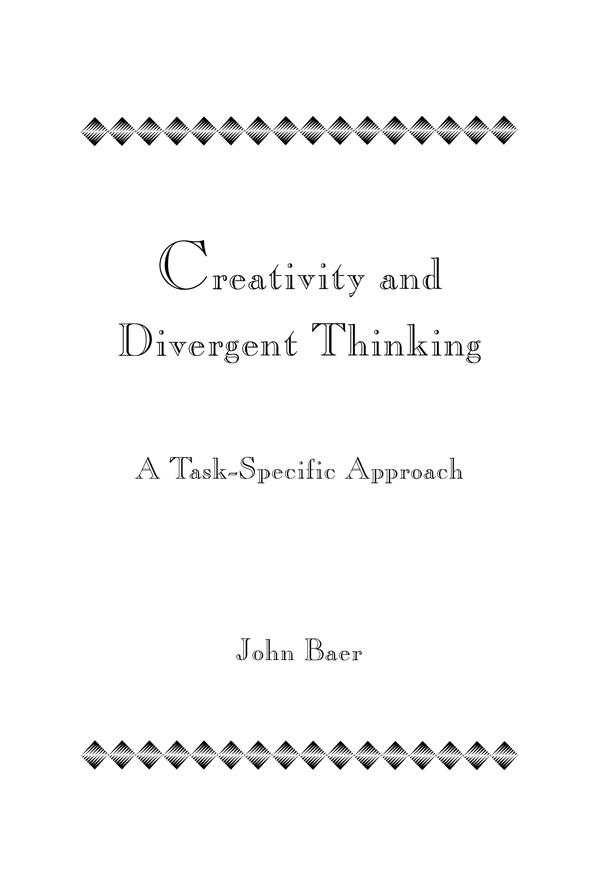
Do general-purpose creative-thinking skills -- skills like divergent thinking, which is touted as an important component of creative thinking no matter what the task domain -- actually make much of a contribution to creative performance? Although much recent research argues against such domain-transcending skills -- including several new studies reported in this book -- the appeal of such general skills remains strong, probably because of the theoretical economy and power such skills would provide. Divergent thinking, in particular, has had an incredible staying power. Despite its many flaws, divergent thinking remains the most frequently used indicator of creativity in both creativity research and educational practice, and divergent thinking theory has a strong hold on everyday conceptions of what it means to be creative.
Reviewing the available research on divergent thinking, this book presents a framework for understanding other major theories of creativity, including Mednick's associative theory and a possible connectionist approach of creativity. It reports a series of studies (including the study that won APA's 1992 Berlyne Prize) that demonstrate the absence of effects of general creative-thinking skills across a range of creativity-relevant tasks, but indicate that training in divergent thinking does in fact improve creative performance across diverse task domains. The book then ties these findings together with a multi-level theory, in which a task-specific approach to creativity is strengthened by recasting some divergent-thinking concepts into domain- and task-specific forms.
This book fills the gap between divergent-thinking theory and more recent, modular conceptions of creativity. Rather than advocate that we simply discard divergent thinking -- an approach that hasn't worked, or at least hasn't happened, because of many attacks on its validity and usefulness -- this book shows how to separate what is useful in divergent-thinking theory and practice from what is not. It shows that divergent-thinking training can be valuable, although often not for the reasons trainers think it works. And it offers specific suggestions about the kinds of creativity research most needed today.
Before Memmo my notes were scattered across PDFs. Now a workspace pulls everything into one place — I see exactly what's still left to study.
Memmo's summaries are gold before exams. I don't have to re-read 800 pages two weeks before — just the important parts.
The AI chat has saved me the night before an exam more than once. I just keep asking until I get it — no waiting on a study group to reply.
The quizzes hit exactly what I need to know. Memmo tracks what I get stuck on — so I only practice what's worth it.
Flashcards with spaced repetition are magic. Memmo knows when I'm about to forget something and brings it back.
The AI podcasts are my favorite. I listen on my way to school and get a recap without sitting at a computer.

Handbok i kvalitativa metoder
281 kr

Hållbar utveckling: en introduktion för ingenjörer och andra problemlösare
334 kr

Brymans Samhällsvetenskapliga metoder
390 kr

Projektledning
491 kr

Den orättvisa hälsan: om socioekonomiska skillnader i hälsa och livslängd
326 kr

Organizational Leadership
429 kr

Vetenskapsteori för nybörjare
196 kr

På väg mot läraryrket
172 kr

Det sociala livet i skolan: Socialpsykologiska perspektiv
253 kr

Betygsättningens didaktik
151 kr

Personality
402 kr

Studying Leadership
404 kr

Managing Innovation
477 kr

Introduktion till samhällsvetenskaplig metod
347 kr

The Psychology of Sex and Gender
698 kr

Evidens och kunskap för socialt arbete
207 kr

Introduction to Leadership
605 kr