
Before Memmo my notes were scattered across PDFs. Now a workspace pulls everything into one place — I see exactly what's still left to study.
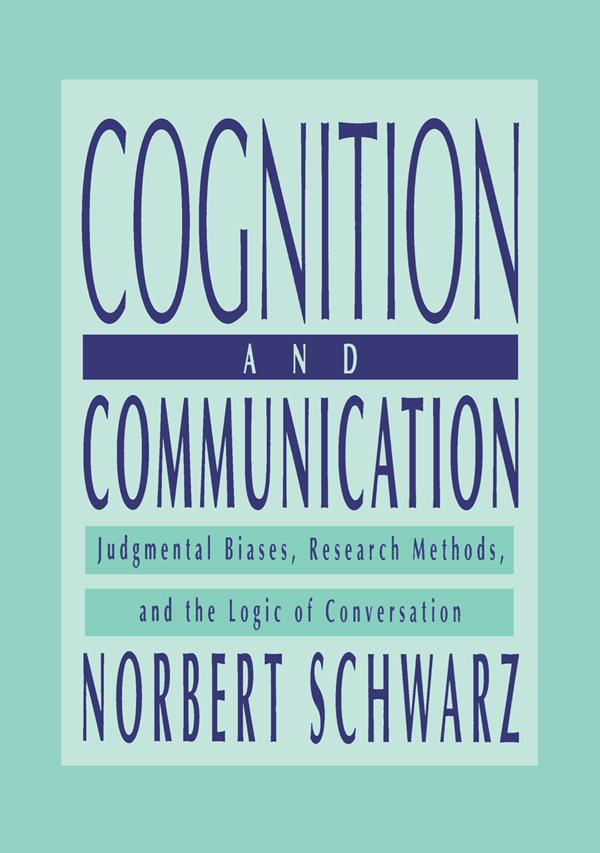
Psychological research into human cognition and judgment reveals a wide range of biases and shortcomings. Whether we form impressions of other people, recall episodes from memory, report our attitudes in an opinion poll, or make important decisions, we often get it wrong. The errors made are not trivial and often seem to violate common sense and basic logic. A closer look at the underlying processes, however, suggests that many of the well known fallacies do not necessarily reflect inherent shortcomings of human judgment. Rather, they partially reflect that research participants bring the tacit assumptions that govern the conduct of conversation in daily life to the research situation. According to these assumptions, communicated information comes with a guarantee of relevance and listeners are entitled to assume that the speaker tries to be informative, truthful, relevant, and clear. Moreover, listeners interpret the speakers' utterances on the assumption that they are trying to live up to these ideals.
This book introduces social science researchers to the "logic of conversation" developed by Paul Grice, a philosopher of language, who proposed the cooperative principle and a set of maxims on which conversationalists implicitly rely. The author applies this framework to a wide range of topics, including research on person perception, decision making, and the emergence of context effects in attitude measurement and public opinion research. Experimental studies reveal that the biases generally seen in such research are, in part, a function of violations of Gricean conversational norms. The author discusses implications for the design of experiments and questionnaires and addresses the socially contextualized nature of human judgment.
Before Memmo my notes were scattered across PDFs. Now a workspace pulls everything into one place — I see exactly what's still left to study.
Memmo's summaries are gold before exams. I don't have to re-read 800 pages two weeks before — just the important parts.
The AI chat has saved me the night before an exam more than once. I just keep asking until I get it — no waiting on a study group to reply.
The quizzes hit exactly what I need to know. Memmo tracks what I get stuck on — so I only practice what's worth it.
Flashcards with spaced repetition are magic. Memmo knows when I'm about to forget something and brings it back.
The AI podcasts are my favorite. I listen on my way to school and get a recap without sitting at a computer.

Handbok i kvalitativa metoder
281 kr

Hållbar utveckling: en introduktion för ingenjörer och andra problemlösare
334 kr

Brymans Samhällsvetenskapliga metoder
390 kr

Projektledning
491 kr

Den orättvisa hälsan: om socioekonomiska skillnader i hälsa och livslängd
326 kr

Vetenskapsteori för nybörjare
196 kr

Organizational Leadership
429 kr

På väg mot läraryrket
172 kr

Det sociala livet i skolan: Socialpsykologiska perspektiv
253 kr

Betygsättningens didaktik
151 kr

Personality
402 kr

Studying Leadership
404 kr

Managing Innovation
477 kr

Introduktion till samhällsvetenskaplig metod
347 kr

The Psychology of Sex and Gender
698 kr

Evidens och kunskap för socialt arbete
207 kr

Introduction to Leadership
605 kr