
Before Memmo my notes were scattered across PDFs. Now a workspace pulls everything into one place — I see exactly what's still left to study.
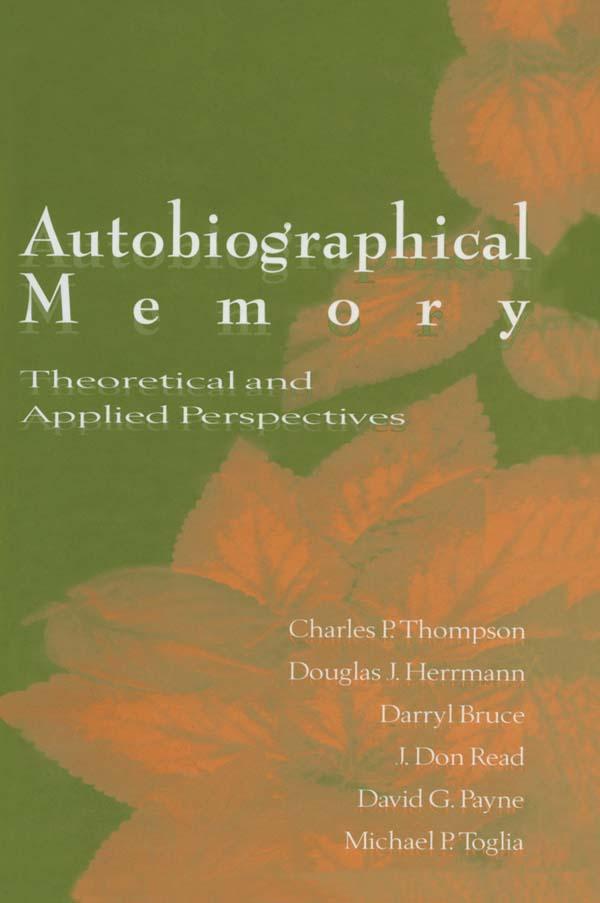
The organization of the first Society for Applied Research in Memory and Cognition (SARMAC) conference centered around two specifically identifiable research topics -- autobiographical memory and eyewitness memory. These two areas -- long-time staples on the menu of investigators of memory in more natural settings -- differ on a variety of dimensions, perhaps most notably in their specific goals for scientific inquiry and application. For many questions about memory and cognition that are of interest to scientific psychology, there have been historical as well as rather arbitrary reasons for their assignment to the autobiographical or eyewitness memory fields.
Perhaps as a result of differing historical orientations, the first volume's seven autobiographical memory chapters focus upon the qualities or types of recall from research participants, whereas the seven chapters in the eyewitness memory volume generally focus upon the quantity (a concern for completeness) and accuracy of recall. This interest in the ultimate end-product and its application within the legal process in general encourages eyewitness memory investigators to modify their testing procedures continually in an attempt to gain even more information from participants about an event. Indeed, several of the eyewitness memory chapters reflect such attempts.
Beyond the specific contributions of each chapter to the literature on autobiographical and eyewitness memory, the editors hope that the reader will come away with some general observations:
* the autobiographical and eyewitness memory fields are thriving;
* these two fields are likely to remain center stage in the further investigation of memory in natural contexts;
* although the autobiographical and eyewitness memory chapters have been segregated in these two volumes, the separation is often more arbitrary than real and connections between the two areas abound;
* the two research traditions are entirely mindful of fundamental laboratory methods, research, and theory -- sometimes drawing their research inspirations from that quarter; and
* the two fields -- though driven largely by everyday memory concerns -- can contribute to a more basic understanding of memory at both an empirical and a theoretical level.
Before Memmo my notes were scattered across PDFs. Now a workspace pulls everything into one place — I see exactly what's still left to study.
Memmo's summaries are gold before exams. I don't have to re-read 800 pages two weeks before — just the important parts.
The AI chat has saved me the night before an exam more than once. I just keep asking until I get it — no waiting on a study group to reply.
The quizzes hit exactly what I need to know. Memmo tracks what I get stuck on — so I only practice what's worth it.
Flashcards with spaced repetition are magic. Memmo knows when I'm about to forget something and brings it back.
The AI podcasts are my favorite. I listen on my way to school and get a recap without sitting at a computer.

Handbok i kvalitativa metoder
281 kr

Hållbar utveckling: en introduktion för ingenjörer och andra problemlösare
334 kr

Brymans Samhällsvetenskapliga metoder
390 kr

Projektledning
491 kr

Den orättvisa hälsan: om socioekonomiska skillnader i hälsa och livslängd
326 kr

Organizational Leadership
429 kr

Vetenskapsteori för nybörjare
196 kr

På väg mot läraryrket
172 kr

Det sociala livet i skolan: Socialpsykologiska perspektiv
253 kr

Betygsättningens didaktik
151 kr

Personality
402 kr

Studying Leadership
404 kr

Managing Innovation
477 kr

Introduktion till samhällsvetenskaplig metod
347 kr

The Psychology of Sex and Gender
698 kr

Evidens och kunskap för socialt arbete
207 kr

Introduction to Leadership
605 kr