
Before Memmo my notes were scattered across PDFs. Now a workspace pulls everything into one place — I see exactly what's still left to study.
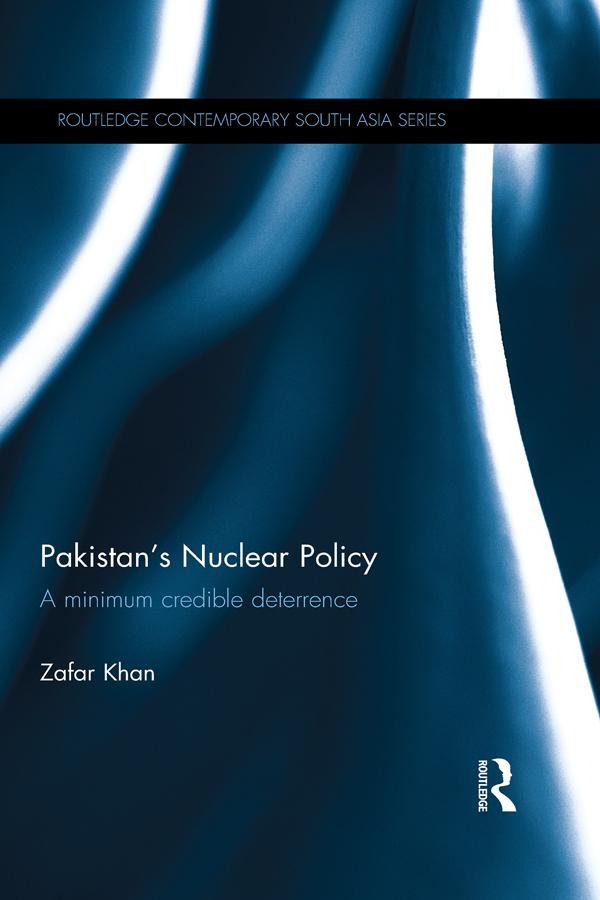
In May 1998, in reaction to India’s nuclear weapons tests, Pakistan tested six nuclear weapons. Following this, the country opted for a policy of minimum deterrence, and within a year Pakistan had altered its policy stance by adding the modifier of minimum ‘credible’ deterrence. This book looks at how this seemingly innocuous shift seriously impacted on Pakistan’s nuclear policy direction and whether the concept of minimum has lost its significance in the South Asian region’s changed/changing strategic environment.
After providing a brief historical background exploring why and how Pakistan carried out the nuclear development program, the book questions why Pakistan could not sustain the minimum deterrence that it had conceptualized in the immediate aftermath of the 1998 test. It examines the conceptual theoretical framework of the essentials of minimum deterrence in order to question whether Pakistan’s nuclear policy remained consistent with this, as well as to discover the rudimentary factors that are responsible for the inconsistencies with regard to minimum deterrence conceived in this study. The book goes on to look at the policy options that Pakistan had after acquiring the nuclear capability, and what the rationale was for selecting minimum deterrence. The book not only highlights Pakistan deterrent force building, but also analyzes closely Pakistan’s doctrinal posture of first use option. Furthermore, it examines the policy towards arms control and disarmament, and discusses whether these individual policy orientations are consistent with the minimum deterrence.
Conceptually providing a deeper understanding of Pakistan’s post-1998 nuclear policy, this book critically examines whether the minimum deterrence conceived could be sustained both at the theoretical and operational levels. It will be a useful contribution in the field of Nuclear Policy, Security Studies, Asian Politics, Proliferation/Non-Proliferation Studies, and Peace Studies. This book will be of interest to policy makers, scholars, and students of nuclear policy, nuclear proliferation and arms control related research.
Before Memmo my notes were scattered across PDFs. Now a workspace pulls everything into one place — I see exactly what's still left to study.
Memmo's summaries are gold before exams. I don't have to re-read 800 pages two weeks before — just the important parts.
The AI chat has saved me the night before an exam more than once. I just keep asking until I get it — no waiting on a study group to reply.
The quizzes hit exactly what I need to know. Memmo tracks what I get stuck on — so I only practice what's worth it.
Flashcards with spaced repetition are magic. Memmo knows when I'm about to forget something and brings it back.
The AI podcasts are my favorite. I listen on my way to school and get a recap without sitting at a computer.

Handbok i kvalitativa metoder
281 kr

Hållbar utveckling: en introduktion för ingenjörer och andra problemlösare
334 kr

Brymans Samhällsvetenskapliga metoder
390 kr

Projektledning
491 kr

Den orättvisa hälsan: om socioekonomiska skillnader i hälsa och livslängd
326 kr

Vetenskapsteori för nybörjare
196 kr

Organizational Leadership
429 kr

På väg mot läraryrket
172 kr

Det sociala livet i skolan: Socialpsykologiska perspektiv
253 kr

Betygsättningens didaktik
151 kr

Personality
402 kr

Studying Leadership
404 kr

Managing Innovation
477 kr

Introduktion till samhällsvetenskaplig metod
347 kr

The Psychology of Sex and Gender
698 kr

Evidens och kunskap för socialt arbete
207 kr

Introduction to Leadership
605 kr