
Before Memmo my notes were scattered across PDFs. Now a workspace pulls everything into one place — I see exactly what's still left to study.
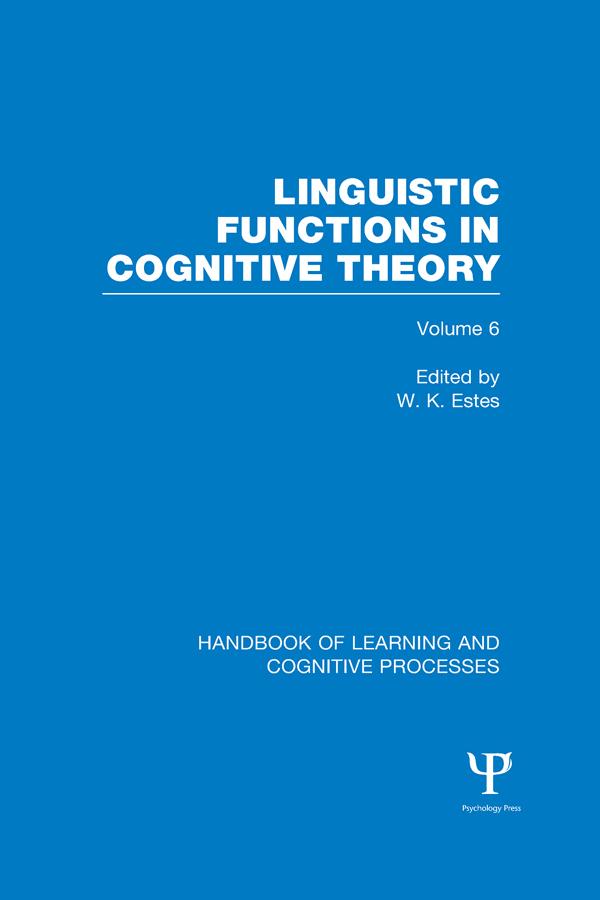
Originally published in 1978, Volume 6 concludes the survey of research and theory on learning and cognitive processes that was envisaged when the plan for this Handbook was sketched.
The primary orientation in the planning the Handbook was to concentrate on research and models aimed toward the development of general cognitive theory.
The first five chapters of this volume are organized in relation to one of the research areas that had expanded most vigorously during the period of planning and writing of the Handbook. These chapters treat aspects of psycholinguistics most closely related to research and theory covered in the other volumes. Perhaps the most fertile source of new concepts and models closely related to other branches of cognitive theory has been research on semantic memory. This work is given a critical review and interpretation by Smith in the first chapter of this volume, following which some lines of theoretical developmental leading "upward" into problems of comprehension of meaningful material are reviewed by Kintsch, then connections "downward" into more elementary problems of coding in memory by Johnson. Also, Johnson’s chapter shades into the very active current body of work on perceptual and memorial processes in reading, carried further by Baron’s examination of perceptual learning in relation to letter and word recognition. Finally, we consider inputs to the psycholinguistic system via speech and speech perception. The strong emphasis of Pisoni’s chapter on speech perception rather than production simply reflects both the predominance of research on perceptual aspects of speech in the current cognitive literature and the close relationships of this research to other lines of investigation of perception and short-term memory.
Some knowledge of the history of the subject and some understanding of the way some of the more persuasive concepts and principles have evolved may serve present-day investigators better than boosting their reading rates. The final chapter of the present volume provides some documentation for this last suggestion.
Before Memmo my notes were scattered across PDFs. Now a workspace pulls everything into one place — I see exactly what's still left to study.
Memmo's summaries are gold before exams. I don't have to re-read 800 pages two weeks before — just the important parts.
The AI chat has saved me the night before an exam more than once. I just keep asking until I get it — no waiting on a study group to reply.
The quizzes hit exactly what I need to know. Memmo tracks what I get stuck on — so I only practice what's worth it.
Flashcards with spaced repetition are magic. Memmo knows when I'm about to forget something and brings it back.
The AI podcasts are my favorite. I listen on my way to school and get a recap without sitting at a computer.

Handbok i kvalitativa metoder
281 kr

Hållbar utveckling: en introduktion för ingenjörer och andra problemlösare
334 kr

Brymans Samhällsvetenskapliga metoder
390 kr

Projektledning
491 kr

Den orättvisa hälsan: om socioekonomiska skillnader i hälsa och livslängd
326 kr

Organizational Leadership
429 kr

Vetenskapsteori för nybörjare
196 kr

På väg mot läraryrket
172 kr

Det sociala livet i skolan: Socialpsykologiska perspektiv
253 kr

Betygsättningens didaktik
151 kr

Personality
402 kr

Studying Leadership
404 kr

Managing Innovation
477 kr

Introduktion till samhällsvetenskaplig metod
347 kr

The Psychology of Sex and Gender
698 kr

Evidens och kunskap för socialt arbete
207 kr

Introduction to Leadership
605 kr