
Before Memmo my notes were scattered across PDFs. Now a workspace pulls everything into one place — I see exactly what's still left to study.
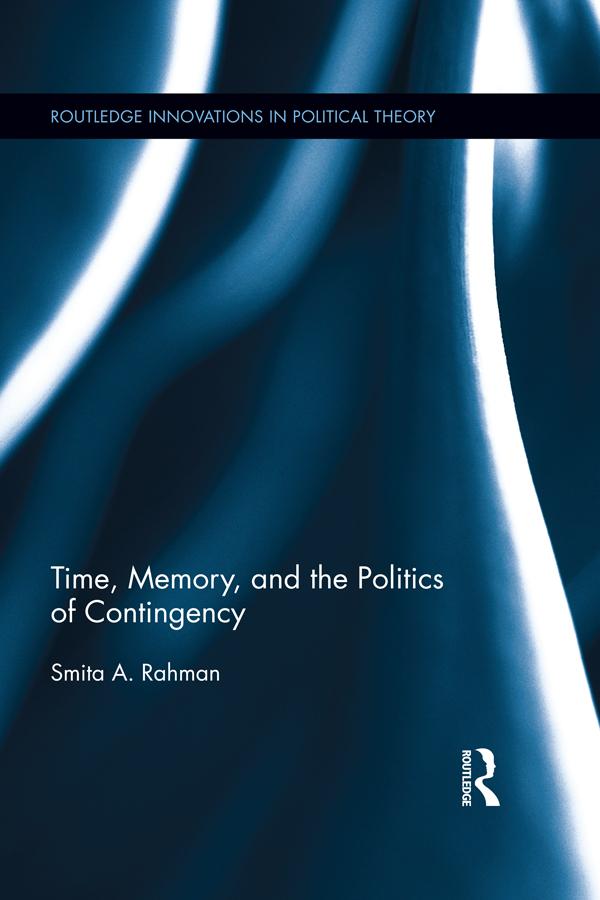
In recent years, there has been an increased attention to temporality in political theory, and such attention is sorely needed. For too long political theory, with the exception of occasional phenomenological forays, has remained grounded in a particular experience of time as linear and sequential. This book aims to unsettle the dominant framework by putting time itself, and the experience of time in everyday life, at the center of its critical analysis.
Smita Rahman focuses on the experience of time as one where past, present, and future intermingle with each other and refuse to adhere to a sequential structure. Rather than trying to tame the flux of time, this book places this "out of joint" experience of time at the center of its analysis of global politics. Rahman takes the highly abstract concept of time and decenters it to speak to a wide range of political issues across disciplines. She does so by exposing the cultural construction of the foundational concept of time in political theory and attending closely to the challenges of cultural incommensurability that it encounters in a globalized world of difference. Specifically, the book looks at interrogation practices in Afghanistan, the challenges of coping with the burdens of collective memory in Algeria, South Africa, and Rwanda, the difficulty of uncritically applying such a framework to the Muslim world through the language of secularism, and finally at the beginnings of democratic emergence in Bangladesh to explore a politics of contingency.
By focusing on issues of contemporary global politics through the lens of political theory, this book draws on literature across disciplines and explores the complex image of time by engaging the work of thinkers for whom time and memory have emerged as a critical issue of analysis, and unpacking the politics of contingency that emerge from such a reading. The book’s new insights on political temporality will interest scholars of contemporary political theory, comparative political theory, critical theory, human rights, conflict studies, and religion and politics.
Before Memmo my notes were scattered across PDFs. Now a workspace pulls everything into one place — I see exactly what's still left to study.
Memmo's summaries are gold before exams. I don't have to re-read 800 pages two weeks before — just the important parts.
The AI chat has saved me the night before an exam more than once. I just keep asking until I get it — no waiting on a study group to reply.
The quizzes hit exactly what I need to know. Memmo tracks what I get stuck on — so I only practice what's worth it.
Flashcards with spaced repetition are magic. Memmo knows when I'm about to forget something and brings it back.
The AI podcasts are my favorite. I listen on my way to school and get a recap without sitting at a computer.

Handbok i kvalitativa metoder
281 kr

Hållbar utveckling: en introduktion för ingenjörer och andra problemlösare
334 kr

Brymans Samhällsvetenskapliga metoder
390 kr

Projektledning
491 kr

Den orättvisa hälsan: om socioekonomiska skillnader i hälsa och livslängd
326 kr

Vetenskapsteori för nybörjare
196 kr

Organizational Leadership
429 kr

På väg mot läraryrket
172 kr

Det sociala livet i skolan: Socialpsykologiska perspektiv
253 kr

Betygsättningens didaktik
151 kr

Personality
402 kr

Studying Leadership
404 kr

Managing Innovation
477 kr

Introduktion till samhällsvetenskaplig metod
347 kr

The Psychology of Sex and Gender
698 kr

Evidens och kunskap för socialt arbete
207 kr

Introduction to Leadership
605 kr