
Before Memmo my notes were scattered across PDFs. Now a workspace pulls everything into one place — I see exactly what's still left to study.
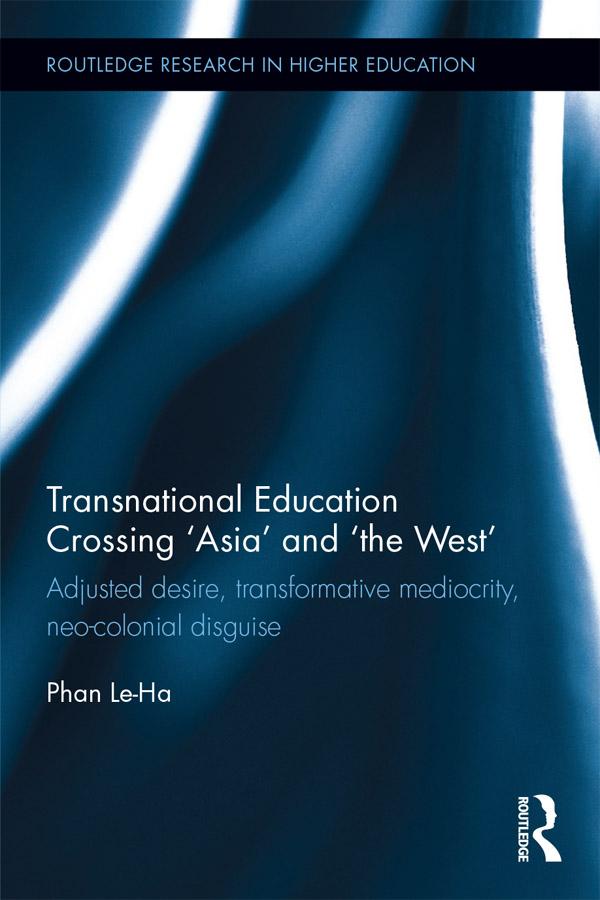
In this book, Phan Le-Ha identifies and discusses four growing self-sustained/sustaining fundamental phenomena in transnational education (TNE), namely (1) the planned, evolving and transformative mediocrity behind the endorsement of English-medium education legitimized by the interactive Asia-the West relationship; (2) the strategic employment of the terms ‘Asia/Asian’ and ‘West/Western’ by all stakeholders in their perceptions and construction of choice, quality, rigour, reliability and attractiveness of programs, courses, and locations; (3) the adjusted desire for an imagined (and often misinformed) ‘West’ among various stakeholders of transnational education; and (4) the assigned and self-realized ownership of English by otherwise normally on-the-margin groups of speakers. A focus on how these phenomena impact questions of identity and desire in TNE is a running theme.
The above phenomena are discussed against the backdrop of ‘the rise of Asia’ sentiment and how this sentiment has played out in interactions and relationships between ‘the West’ and ‘Asia’ and among Asian institutions and various entities. Phan Le-Ha’s examination of the identified phenomena in TNE has been informed by her multi-layered engagement with the dialectic of the Asia-the West relationship, her critical take on certain pro-Asia and decolonisation scholarship, and her interdisciplinary and multidisciplinary approach to theorise the field and the specific topic under scrutiny.
Phan Le-Ha shows that the current Asia chooses (not necessarily by force but largely by will and often with an informed and well-articulated agency) to go with the idea of the West and often desires an affiliation with the West either directly or indirectly, something that is getting more intense in the context of globalization, regionalization, and commercialization of education. The rise of Asia has made the idea of the West even more looked-for in Asia. TNE in Asia, in many ways, is the transforming and dynamic transit point, a layover that facilitates entry into a wanted destination – the West and/or the idea of the West. The West and Asia need one another more than ever in the context of the internationalization and commercialization of higher education. What’s more, the West and Asia have hardly ever been mutually exclusive but have rather been in an eventful love-and-obsession relationship with each other. This is the very dialectic proposition that Phan Le Ha takes throughout this book while paying specific attention to transnational higher education in the greater Asian region including the Middle East, following her several research projects conducted in the region since 2005 to date.
Transnational Education Crossing 'the West' and 'Asia' explores:
• English, Internationalisation of Higher Education, and Identity: Increasing Academic Monolingualism and English-only Package
• Transnational Education and Dream Realization: From the Philippines to Vietnam, From Afghanistan to Dubai, From Everywhere in Asia to Thailand
• Desiring International /Transnational Education: Theorisation of Key Concepts and Next Steps from Here
The book will be of interest to researchers in the field of transnational education, Asia education and education policy.
Before Memmo my notes were scattered across PDFs. Now a workspace pulls everything into one place — I see exactly what's still left to study.
Memmo's summaries are gold before exams. I don't have to re-read 800 pages two weeks before — just the important parts.
The AI chat has saved me the night before an exam more than once. I just keep asking until I get it — no waiting on a study group to reply.
The quizzes hit exactly what I need to know. Memmo tracks what I get stuck on — so I only practice what's worth it.
Flashcards with spaced repetition are magic. Memmo knows when I'm about to forget something and brings it back.
The AI podcasts are my favorite. I listen on my way to school and get a recap without sitting at a computer.

Handbok i kvalitativa metoder
281 kr

Hållbar utveckling: en introduktion för ingenjörer och andra problemlösare
334 kr

Brymans Samhällsvetenskapliga metoder
390 kr

Projektledning
491 kr

Den orättvisa hälsan: om socioekonomiska skillnader i hälsa och livslängd
326 kr

Vetenskapsteori för nybörjare
196 kr

Organizational Leadership
429 kr

På väg mot läraryrket
172 kr

Det sociala livet i skolan: Socialpsykologiska perspektiv
253 kr

Betygsättningens didaktik
151 kr

Personality
402 kr

Studying Leadership
404 kr

Managing Innovation
477 kr

Introduktion till samhällsvetenskaplig metod
347 kr

The Psychology of Sex and Gender
698 kr

Evidens och kunskap för socialt arbete
207 kr

Introduction to Leadership
605 kr